Aleksander Kleszer, known to his family as Oluś, is only six years old, yet he has faced battles most adults could scarcely imagine. A boy who should be running freely, laughing with friends, and exploring the world with carefree delight is instead locked in a fight for his very survival.
At such a tender age, he has already come to know the cold and relentless reality of a severe illness that threatens not just his future but his present, every day. The enemy he faces is a neuroblastoma in its most advanced stage, stage IV—a malignant cancer of the nervous system that is notoriously aggressive and exceptionally difficult to treat. For Aleksander, life has become an intricate web of hospital visits, treatments, medications, and the unwavering vigilance of his devoted parents.

The story began innocently enough, with subtle changes in his health that could have been overlooked. He complained of vague pains in his legs, experienced bouts of nausea, and showed signs of fatigue that were atypical for a child of his energy and curiosity. His parents, concerned but hopeful, took him to the local hospital. There, after a series of urgent tests, they received the diagnosis that would shatter their world: neuroblastoma stage IV, a condition so severe that it demanded immediate intervention. In an instant, their lives were no longer guided by ordinary routines or simple pleasures; they became a life dictated by survival, by the necessity to fight a disease that waits for no one.
The first months were grueling. Immediate treatment began, including chemotherapy, designed to slow the growth of the tumor and buy time for further intervention. Every session was a trial of endurance for Aleksander, his tiny body enduring harsh medications that left him weak, nauseated, and exhausted. His parents watched over him, offering comfort, holding his hand through long infusions, wiping tears from his cheeks, and whispering words of encouragement that only a parent could find in such dark hours. The boy learned to endure pain with courage that belied his years, never fully understanding the severity of his condition but trusting implicitly in the love and care surrounding him.
At home, the absence of normal childhood activities weighed heavily. His four-year-old sister watched from a distance, longing for the days when they could play together, unaware of the severity of her brother’s condition. Each evening she would ask when he would come back to play, her innocent questions cutting through the grief that filled the home. The parents, already stretched to the limits of emotional and physical endurance, found themselves juggling medical care, household responsibilities, and the emotional needs of their daughter—all while navigating the complex world of oncology treatments for a child.
Despite the immense challenges, there were moments of hope. After months of chemotherapy, imaging revealed that the tumor had begun to shrink, a sign that Aleksander’s body was responding to treatment. It was a fragile victory, one that offered a glimmer of light amid the darkness. His parents clung to this progress, recognizing that every millimeter of reduction in tumor size represented not just a physical improvement, but a psychological victory, proof that their son’s indomitable spirit and the resilience of his body could defy the odds.
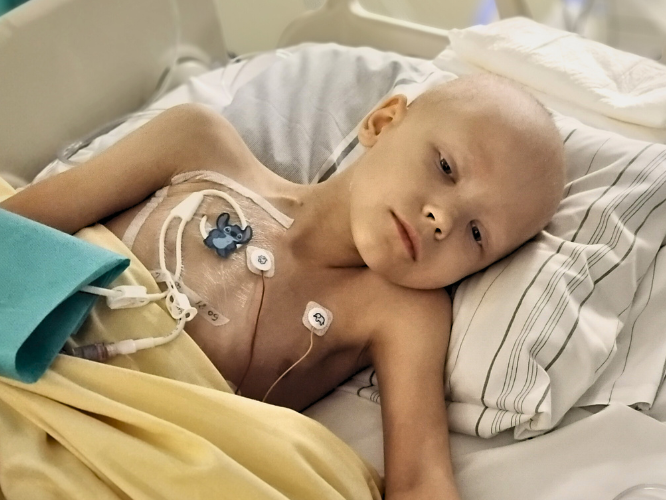
Yet the path forward remained treacherous. Neuroblastoma is notorious for its unpredictability, and while some tumors respond favorably to standard therapies, others require cutting-edge interventions. Aleksander’s medical team identified a potential lifeline: a specialized vaccine designed to prevent recurrence, unavailable in Poland, accessible only through an advanced international clinic. This treatment, highly personalized and expensive, represented perhaps the only chance to give Aleksander a sustained future, to preserve the life and potential of a child who had already endured so much.
The financial burden of such therapy is staggering. The cost of the vaccine, combined with travel expenses, accommodation near the clinic, and additional medications, far exceeds what his family can bear. Each day that passes is a delicate balance between hope and desperation, as every moment delayed in securing treatment increases the risk to Aleksander’s fragile life. Yet, even amid this uncertainty, his parents remain steadfast, launching urgent appeals to the wider community, sharing their son’s story with the world, and asking for help to secure the funds necessary for his survival.
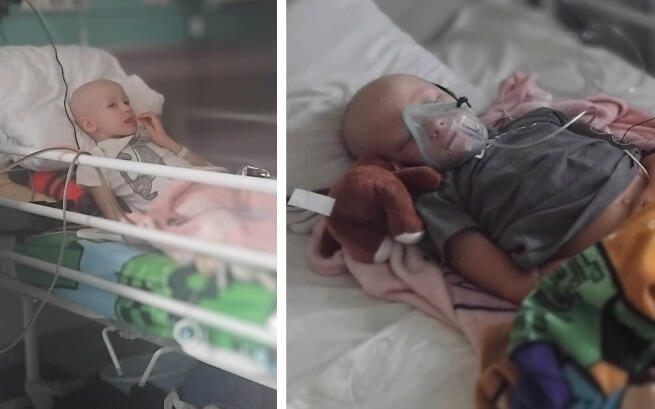
Aleksander’s courage is remarkable. Despite chemotherapy sessions that leave him pale and weak, he retains a playful spark, a curiosity that shines through his fatigue, and an innocence that no illness can entirely suppress. His laughter, when it comes, is a testament to resilience; his smiles, fleeting yet precious, are proof that even in the midst of suffering, a child’s spirit can endure. Every small milestone—a bite of food, a step taken with assistance, a reaction to a familiar voice—is celebrated with the intensity and gratitude reserved for miracles.
His parents’ dedication is extraordinary. Every day, they manage complex medication schedules, ensure that all procedures are followed precisely, and provide constant emotional support. They advocate tirelessly for his care, coordinating with medical specialists, arranging travel logistics for international treatment, and offering Aleksander a semblance of normalcy amid the chaos. Their devotion transforms fear into action, despair into determination, and helplessness into a tangible effort to save their child.
The broader community has responded with extraordinary generosity. Donations have poured in from individuals, organizations, and even strangers moved by the courage of a six-year-old fighting for his life. Each contribution is more than financial support; it is a lifeline, a testament to collective humanity, and a message to Aleksander that the world believes in him, in his right to live, to grow, and to experience a full childhood. Every shared social media post, every forwarded message, every word of encouragement contributes to a network of hope, knitting together resources and emotional support in a tangible form that can directly impact his survival.
Time is critical. Each day delayed in receiving treatment is a risk to Aleksander’s life. The tumor’s aggressiveness leaves no room for procrastination. His family’s appeals highlight not just the urgency of the situation, but the precision with which every step must be taken to preserve his chance at life. The vaccine and associated care represent not just a medical intervention, but a symbol of possibility, a bridge between illness and recovery, between despair and hope.
Throughout his ordeal, Aleksander demonstrates the remarkable resilience of children. Even as he endures pain, discomfort, and fatigue, he maintains a spark of curiosity and joy. His fascination with small details, his response to familiar voices, and his occasional laughter show that his spirit has not been dimmed by disease. These moments, fleeting though they may be, are profoundly impactful for those around him, serving as reminders that hope persists even in the darkest circumstances.
The story of Aleksander also underscores the broader challenges facing pediatric cancer patients. Access to specialized treatments can be limited, costs are prohibitive, and families are often pushed to the brink of emotional and financial exhaustion. The fight against childhood cancer is not only a medical struggle but a societal one, requiring awareness, compassion, and collective action. Aleksander’s case illuminates the need for broader support systems, faster access to innovative therapies, and a coordinated effort to ensure that no child is left behind due to financial constraints.
For his parents, every day is a combination of vigilance, advocacy, and love. They administer medications, ensure that treatment schedules are followed meticulously, and provide constant emotional nurturing. They create moments of joy wherever possible, celebrating every small improvement, holding their son’s hand through every procedure, and maintaining a household environment infused with hope. Their tireless efforts remind us that parental love is not passive but active, transformative, and sometimes the most critical force in a child’s recovery.
Aleksander’s journey has captured hearts far beyond his local community. Stories of his resilience, his family’s devotion, and the urgent call for help have reached thousands, creating a network of empathy and action that exemplifies the power of human solidarity. Each act of kindness is a building block, reinforcing the structure of hope that surrounds him, enabling him to face each new challenge with courage and a renewed chance at life.
Despite the uncertainty, Aleksander’s spirit remains unbroken. He embodies the possibility of survival even in dire circumstances, demonstrating that courage and determination are not confined by age. Every smile, every sign of engagement, every moment of playful curiosity is a testament to the extraordinary resilience of the human spirit, especially within a child facing life-threatening illness.
His story serves as a clarion call, highlighting the critical importance of timely medical intervention, community support, and unwavering advocacy. It reminds us that every child’s life is invaluable and that collective action can provide tangible, life-saving opportunities. Aleksander’s battle is not only about surviving the disease but reclaiming the childhood that illness has interrupted, asserting the right of a child to live fully, learn, play, and dream.
The urgency of Aleksander’s situation cannot be overstated. Each day brings new risks, yet each day also offers the possibility of hope. The vaccine therapy represents a tangible chance to halt disease progression and provide him with a future. In a world where medical innovation and human empathy intersect, Aleksander’s fight exemplifies the profound impact of coordinated action and community generosity. Every contribution, no matter how small, represents a step toward the preservation of his life, the safeguarding of his childhood, and the affirmation of his potential.
As he prepares for treatment abroad, every heartbeat and every small response is a victory. Aleksander’s story is a profound reminder of the vulnerability and resilience of children facing life-threatening illnesses, the extraordinary dedication of parents, and the transformative power of collective human compassion. It is a story that continues to unfold, urging all who hear it to recognize the preciousness of life, the urgency of timely intervention, and the immeasurable value of hope in sustaining it.
Through every moment of struggle, every display of courage, and every small triumph, Aleksander Kleszer teaches those around him the meaning of perseverance, the depth of parental love, and the vital role of community in the fight against disease. His journey, while fraught with uncertainty, illuminates the profound impact of human compassion and action in the face of seemingly insurmountable odds.
Aleksander’s fight is ongoing, and every gesture of support contributes to the preservation of his life and the possibility of a future filled with hope, joy, and the full experience of childhood. He is not merely a patient; he is a symbol of courage, resilience, and the enduring power of human connection. His story is a testament to the fact that even in the darkest times, when illness threatens to overshadow life itself, the collective determination and compassion of humanity can create pathways to survival, healing, and renewed possibility.