There are some names that stay with you long after you hear them—names that seem to shimmer with light, even when the story behind them is shadowed by heartbreak.
Parker LeAnn Monhollon is one of those names.

She was only nine years old when she left this world on July 10, 2017. Yet in those nine short years, she lived with more courage, joy, and fire than many do in a lifetime. To her family and to the thousands who followed her story, she wasn’t just a child battling a rare and devastating illness—she was the embodiment of resilience, a dancer who kept moving even when her body began to betray her.
This is the story of the little girl who refused to stop shining, even as her world grew dark.

A Heart That Wasn’t Supposed to Last
When Parker was born on July 26, 2007, doctors warned her parents to prepare for the worst. Their baby girl came into the world with multiple heart defects—conditions that usually require major surgery before a child reaches six months old.
But Parker was different.

Week after week, her parents brought her in for echo cardiograms, bracing for the moment when doctors would say it was time. But that day never came. Each time, the news was the same: her heart was still doing its job. Against all odds, surgery was not needed.

From the beginning, it seemed Parker’s heart had its own way of beating—strong, steady, and defiant.
And that same heart would later become her greatest weapon in a far deadlier battle.

A Spark That Lit Up Every Room
To know Parker was to know energy. She was the girl who couldn’t sit still for long, who loved to dance in the living room until she fell over laughing. Her family often joked that she had two speeds: fast and faster.

She was sassy, funny, and endlessly curious. She made YouTube videos with her siblings, filmed impromptu performances, and dreamed of one day becoming a professional dancer. Her spirit was electric, her personality magnetic—people couldn’t help but be drawn to her.

Her mother, Amanda, remembers her as “the kind of girl who could make a room brighter just by walking in.”
But that light, as bright as it was, was about to be tested in a way no child—or parent—should ever have to face.

The Week Before Christmas
It started so quietly, so ordinarily. Just before Christmas, Amanda noticed something unusual: one of Parker’s eyes had started to drift slightly. At first, it seemed harmless—a lazy eye, maybe, or just a phase. But soon, the school nurse called with growing concern. Parker was complaining of double vision. The headaches were becoming frequent.

Amanda scheduled an eye exam, expecting a prescription or perhaps a simple corrective surgery. But when the optometrist looked into Parker’s eyes, he saw something deeper—something that didn’t belong.

He ordered an MRI “just in case.”
No one could have imagined how that simple decision would change everything.

The Day the World Stopped Turning
On January 15, 2016, the results came in. Amanda sat in the sterile glow of the hospital waiting room, listening to words that didn’t seem real.
A tumor.
Near the brain stem.
Inoperable.
Aggressive.

It had a name—DIPG (Diffuse Intrinsic Pontine Glioma)—but that name meant little until the doctors explained what it truly was.
DIPG is one of the cruelest forms of pediatric cancer, attacking the part of the brain that controls basic functions like breathing, movement, and swallowing. It cannot be surgically removed. It rarely responds to treatment. The average survival time: nine months.

Amanda’s world collapsed.
In that moment, the life she had imagined for her daughter—the dances, the birthdays, the laughter—seemed to crumble in front of her. But Parker, sitting in her hospital gown, looked at her mother with the calm confidence of someone twice her age and said softly, “It’s okay, Mom. I’ve got this.”
And somehow, she did.

Fighting the Unfightable
The next 18 months became a blur of hospitals, radiation sessions, and experimental treatments. Parker’s body changed—her hair thinned, her face grew pale—but her spirit never did.
She kept dancing, even in her hospital room, hooked up to IVs. She kept making silly videos for her friends. She kept smiling, even when she could barely stand.

Her parents began sharing her journey online, not for attention, but to build a community of prayer and hope. And that’s exactly what happened. Thousands of people across the country began following “Parker’s Promise,” sending messages, gifts, and love.
What struck everyone wasn’t just her strength—it was her joy.

She laughed at the nurses’ jokes. She decorated her hospital room with Christmas lights. She told her mom, “I want people to see that even when bad things happen, we can still be happy.”
And that’s what she did—she made happiness her mission.

The Girl with the Unbreakable Smile
Even as the disease advanced, Parker refused to let it define her. When she could no longer walk, she learned to dance with her hands. When she could no longer record videos, she dictated them to her mom.
Her family and friends surrounded her with love, creating small moments of normalcy in a life that had become anything but.

There were dance parties in hospital rooms. Ice cream runs on good days. Movie nights that ended in giggles instead of tears.
And through it all, Parker smiled.
She once told her doctor, “You can’t be sad all the time. Sad doesn’t make you better.”
It was simple wisdom—but it became her truth.

A Legacy of Light
By the summer of 2017, Parker’s body was growing tired. The tumor had taken too much. But her mind remained sharp, her faith unshaken.
When people came to visit, she would greet them with the same mischievous grin that had defined her life. She never let anyone forget that she was still Parker—still full of sass, humor, and grace.

On July 10, 2017, surrounded by her family, Parker’s fight came to an end.
She was nine years old.
Her parents called it her “angel day.” It was the day she gained her wings—the day she left behind pain, but not love.

Her passing rippled far beyond her small hometown. Tributes poured in from across the nation. Teachers, doctors, strangers—all spoke of how her courage had changed them.
She was more than a child lost too soon. She was a lesson in strength, in faith, in the kind of light that refuses to fade.

Remembering Parker
In the years since, her family has worked to keep her legacy alive. They’ve shared her story with organizations raising awareness for DIPG, hoping to prevent other families from enduring the same heartbreak.
They’ve organized events in her name—dance recitals, fundraisers, and community projects—all dedicated to spreading the same joy that Parker carried everywhere she went.

Her mother once wrote, “I used to think Parker was born with a broken heart. But now I realize—she was born with the strongest one I’ve ever known.”
Every year, on her birthday, friends and supporters celebrate her life not with silence, but with music. They dance, laugh, and share the stories that keep her spirit alive.

Because Parker wasn’t just a little girl with cancer.
She was a force.
A reminder that even in the face of death, there can still be life.

The Meaning of a Miracle
Parker’s story doesn’t end with her passing—it continues in the countless lives she touched. The doctors who witnessed her courage still speak of her with awe. The families who followed her journey online say she taught them to treasure every ordinary moment.
And for those who loved her most, she remains a quiet presence—a whisper in the music, a smile in the sunlight, a heartbeat in the dance.

Today, she would have been fourteen.
Her mother often imagines what that birthday would look like—Parker in her favorite sparkly dress, spinning in the backyard, laughter echoing through the summer air.
Instead, she celebrates in heaven, surrounded by the angels whose wings she once joined.

And down here, those who knew her still feel her light, still hear her laughter, still carry her message:
That joy is a choice.
That courage is louder than fear.
And that even when life ends, love doesn’t.

Forever Parker
The story of Parker LeAnn Monhollon is not one of tragedy—it’s one of triumph.
She faced the unthinkable and answered it with grace. She met pain with laughter. She lived fully, loved fiercely, and inspired deeply.

Her life, though short, was nothing short of extraordinary.
She may have been just nine years old when she earned her angel wings, but her legacy continues to dance—in every child who fights, in every parent who hopes, and in every heart brave enough to believe that light can outlast darkness.

Happy Heavenly Birthday, Parker.
Keep dancing.
We’re still watching.
And we’ll never forget.
“She Trusted the System — And It Sent Her to Her Death”. 3156
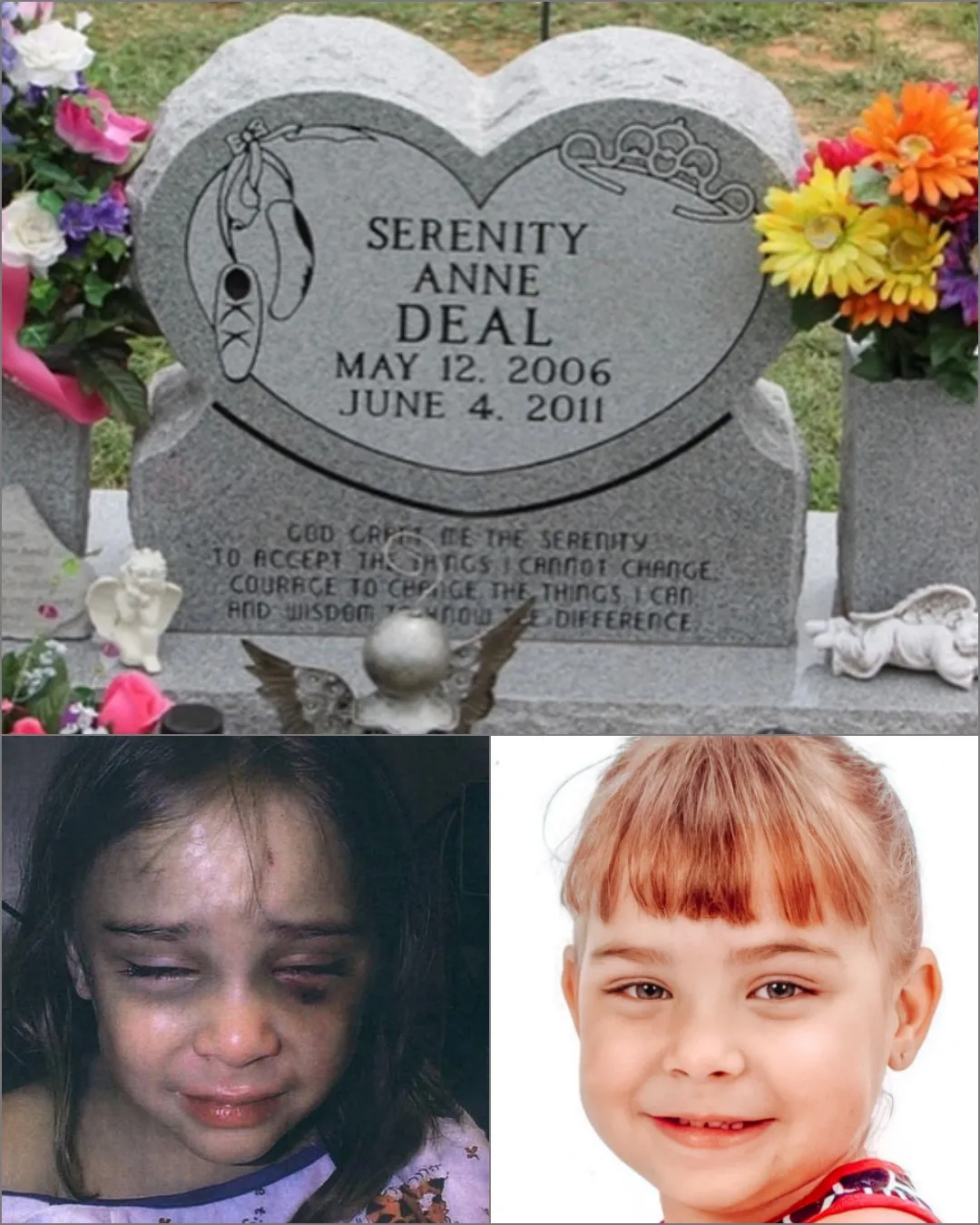
Serenity Anne Deal was born on May 12, 2006.
A bright, sweet little girl with big brown eyes and a name that meant peace.
But for Serenity, there was never much peace — not in her short five years on this earth, and not in the system that was supposed to keep her safe.
On June 4, 2011, Serenity’s life ended in unimaginable violence.
She was beaten to death by her father, the very person the Oklahoma Department of Human Services (DHS) had entrusted with her care.
She was only five years old.
A Childhood That Began With Struggle
Serenity’s story began with chaos. Her mother was accused of a sex offense involving a teenage boy, and DHS intervened early in Serenity’s life. She was taken away from her mother and placed in foster care for her own safety.
For a time, she lived with a foster family who loved her deeply. They described her as a joyful child — curious, affectionate, and eager to please. She loved to sing softly to herself before bed, and her favorite color was pink.
Her grandparents, too, longed to bring her home. They wanted to adopt her permanently, to raise her in a home where she would be surrounded by love and stability. But when they tried, their request was denied.
Why?
Because Serenity’s biological father — a man who hadn’t even known he had a daughter until she was three years old — objected.
And from that moment, everything started to unravel.
The Reintroduction
When DHS informed the father that he had a daughter, he reportedly expressed surprise. He had never been involved in Serenity’s life, never provided care or support. But once he knew about her, he demanded parental rights.
DHS began to arrange supervised visits — the kind meant to test whether he could build a relationship with her.
But soon, those visits became unsupervised.
And that’s when the first warning signs appeared.
During overnight stays, Serenity returned to her foster home with bruises and unexplained injuries.
In January 2011, after one of those visits, she was taken to the hospital. A photograph was taken — her small face bruised, her eyes tired and distant.
When asked, both Serenity and her father said it was an accident. He had “dropped her,” they claimed.
The DHS workers accepted that story. They wrote their report, filed it away, and never brought it to court.
That photograph — that single piece of evidence — would later become a symbol of everything the system failed to do.
The Suppressed Evidence
As the case moved forward, two DHS workers — responsible for Serenity’s welfare — continued to advocate that she should live with her father.
They pushed the narrative that a child “belongs with their parent,” even when clear red flags were flashing before them.
In their reports, they described the father as “receptive,” “willing to learn,” and “capable of caring for his child.”
But they never told the judge about the injuries.
They never disclosed the photo taken at the hospital.
They never revealed the father’s violent past.
Later investigations showed that the father had a history of aggression — incidents involving domestic violence and outbursts of rage. But those details were overlooked.
When the court asked DHS whether there was any concern about the father’s ability to care for Serenity, the workers said no.
And with that, the judge signed the papers.
In December 2010, Serenity was placed permanently in her father’s custody.
The Final Months
At first, everything seemed quiet. DHS closed her case and moved on. Serenity’s foster family and grandparents tried to stay in touch, but the contact became less frequent.
Behind closed doors, however, things were far from fine.
Reports would later show that the father had grown frustrated and angry. He struggled with patience and had no real parenting experience. Those close to him described him as unpredictable — sometimes affectionate, sometimes violent.
On the night of June 4, 2011, that unpredictability turned fatal.
The Night Serenity Died
Neighbors later told police they heard shouting, followed by thuds and crying. The noise stopped suddenly, and the house went quiet.
When officers arrived, they found Serenity’s small body — bruised, broken, lifeless.
She had been beaten to death.
An autopsy later confirmed the horrifying truth: Serenity had suffered multiple blows to her head and body. The cause of death was blunt force trauma.
The man who should have protected her, the man the court had chosen to trust, was the one who took her life.
The Aftermath
The news of Serenity’s death shook the community — and it ignited outrage far beyond her hometown.
People demanded answers:
How could this happen?
How could a child with such a clear history of risk be placed with an abuser?
The Oklahoma Department of Human Services immediately came under fire. Two of the workers assigned to Serenity’s case were fired.
In official termination papers, DHS admitted that the employees had “failed to fully investigate the father’s background,” and had “suppressed critical evidence” — including the hospital photograph of Serenity’s injuries.
Both workers were later charged with misdemeanors for withholding evidence from the judge. They pled no contest and were placed on probation.
It was a slap on the wrist for a failure that cost a five-year-old her life.
The Grandparents’ Pain
Serenity’s grandparents were devastated. They had tried everything — they had pleaded to adopt her, warned DHS of the danger, and begged the court to reconsider.
But no one listened.
After her death, they filed a lawsuit against DHS, accusing the department of negligence. They said the agency’s “gross failure” to protect Serenity was directly responsible for her murder.
“If the judge had seen that photo,” said Pottawatomie County District Attorney Richard Smothermon in 2012,
“Serenity would never have been placed with her father.”
The grandparents visit her grave often, leaving flowers, small stuffed animals, and drawings — the kinds of things Serenity used to love.
They remember her laughter, her tiny voice calling them Nana and Papa, her love for butterflies and bedtime stories.
They remember the light she brought into their lives — a light extinguished far too soon.
The Legacy of a Broken System
Serenity’s case became one of the most infamous examples of systemic failure in Oklahoma’s child welfare history.
It exposed deep flaws:
- Caseworkers overloaded and undertrained.
- Judges relying on incomplete information.
- A system that prioritized reunification over safety.
In the years following Serenity’s death, the DHS publicly promised reforms — more accountability, more oversight, and stricter review of parental placements.
But for many, those changes came too late.
Remembering Serenity
Serenity should have been a teenager now — learning to drive, going to school dances, dreaming about her future.
Instead, her story is told as a warning, a plea to never look away when a child is at risk.
Her name — Serenity — means peace.
But peace was denied to her in life.
Maybe, just maybe, it can exist in the truth being told about her death.
Maybe her story can stop another tragedy before it happens again.
In Memory of Serenity Anne Deal
Born: May 12, 2006
Died: June 4, 2011
Forever five years old.
Forever loved.
Never forgotten.
