When I close my eyes, I can still hear it—the rhythm of the monitor, the soft click of the ventilator, the uneven lullaby of our son’s breathing. Those sounds became our world. Not music, not laughter, but the steady hum of machines that kept Theo alive.
I remember the day he was born. The sky outside the hospital window was pale, the kind of color that promises snow but never delivers. His cry was faint, like a question too afraid to be asked. The nurse smiled, told us he was small but strong. We didn’t know then how many times we’d cling to that word—
strong—as if it could hold us together when everything else fell apart.

When Theo was three weeks old, his breathing changed. It started with pauses—a quiet hitch in the rhythm. Then the pauses grew longer. The doctor said his lungs weren’t working the way they should. I remember the flash of red numbers on the monitor, the rush of nurses, the silence before the alarm. That silence—the breathless instant—is burned into me. The moment when I realized I could lose him before I ever got to know him.
We learned words I never wanted to know: apnea, bradycardia, oxygen saturation, invasive ventilation. Words that wrapped around our lives, clinical and cold. The world around us became a series of beeping machines, medical routines, and quiet tension.

But even there, amid the wires and worry, we found small miracles. Theo’s hand, no larger than my thumb, curled around my finger. His skin was translucent, his veins like faint blue rivers beneath a paper-thin surface. But when he gripped me, it was with a force that felt like defiance—as if he was saying,
Don’t you dare give up on me.
And we didn’t. Even when doctors warned us to prepare for the worst. Even when nights stretched too long and mornings brought no relief. My husband and I took shifts—one sleeping in the chair beside him, the other pacing the hallway with coffee gone cold. We whispered prayers not to saints or gods, but to the machines, the nurses, the science that stood between life and loss.
Just one more day. Just one more breath.
And somehow, Theo kept giving them to us.
There was a nurse named Caroline who hummed when she worked—soft, almost absentminded tunes. One night, I asked her why. She smiled and said, “Because babies remember sound before anything else. If he hears calm, he’ll feel calm.”

After that, I started to hum too. Sometimes lullabies, sometimes the songs my mother used to sing while cooking—songs from a world that felt impossibly far away. I didn’t know if Theo could hear me through the wires and the medicine, but I hummed anyway. Because if memory could be built from sound, I wanted his first memories to be made of love.
There were good days too. The day his oxygen levels stayed steady for a whole hour. The first time he opened his eyes long enough for us to see the color—stormy blue, like the sky before rain. The morning he wrapped his hand around my husband’s wedding ring and refused to let go. We learned to measure time differently—not in minutes or days, but in moments of progress: a deeper breath, a steadier heartbeat, a single blink of recognition. Every improvement was a celebration. Every setback, a lesson in patience.
I started keeping a notebook beside his bed—not to track numbers, but to remember. Theo’s breath steady at 10:42 a.m. He smiled today. Maybe it was gas, but it looked real. He held my finger for five seconds longer than yesterday. It wasn’t much, but it was ours—proof that time was still moving forward.
There was a night when I almost broke. Theo’s condition had worsened. His lungs struggled. The doctors spoke in careful tones, avoiding words like irreversible but letting the weight of them hang in the air. I went home that night for the first time in weeks, and the silence hit me like a wave. His toys were still stacked in the corner. The crib we’d built together sat empty. I sat on the floor and cried until dawn. That’s when I realized something: even if Theo didn’t survive, I would never forget him—not just as the fragile boy in the hospital bed, but as the miracle who taught me what love truly means.
When I returned the next morning, the nurse met me with a smile. “He had a good night,” she said. “You should see him.” Theo’s eyes were open. His chest rose and fell—shallow, but steady. And for the first time, he reached up on his own, fingers fluttering toward the light. I didn’t move. I didn’t breathe. I just watched. That memory—that small, quiet miracle—became the moment I learned what hope feels like when it finally takes root.
Months passed. Theo’s fight continued, slow and uneven. But with every struggle came a sign of strength. He began breathing longer without support. He began responding to touch, to voice, to presence. The first time he laughed—a soft, broken sound like wind through paper—I cried so hard the nurse had to steady me. “He remembers you,” she said gently. And maybe that’s what love really is: something so deep it leaves a memory even before words, even before understanding.
Theo is one year old now. He still needs oxygen, still spends more time in hospitals than at home, but he’s alive. He’s here. His father carries him to the window every morning, showing him the sky. “That’s where your strength comes from,” he whispers. “From all the light you’ve pulled through the dark.”
Sometimes, I sit by his crib and close my eyes. I think about everything we’ve survived—the fear, the sleepless nights, the moments when hope was a flicker in the dark. I think about how memory is built not just from what we see, but from what we endure. Theo won’t remember the tubes or the needles or the quiet beeping that cradled him through the nights. But I will. I’ll remember the way he squeezed my hand when I was breaking. The way he smiled when his lungs finally cooperated. The way his heart refused to stop, even when the world around him faltered.
I’ll remember that courage doesn’t always roar. Sometimes, it whispers—one breath, one heartbeat, one moment at a time. And maybe someday, when Theo is old enough to ask what happened, I’ll tell him. I’ll tell him how brave he was, how fiercely he fought. I’ll tell him how every day with him was a miracle I never stopped believing in.
Because even now, long after the fear has softened into memory, I can still hear the rhythm that saved us—the soft, steady echo of life returning, breath by fragile breath.
Taka’s Second Chance: From the Fire to the Light
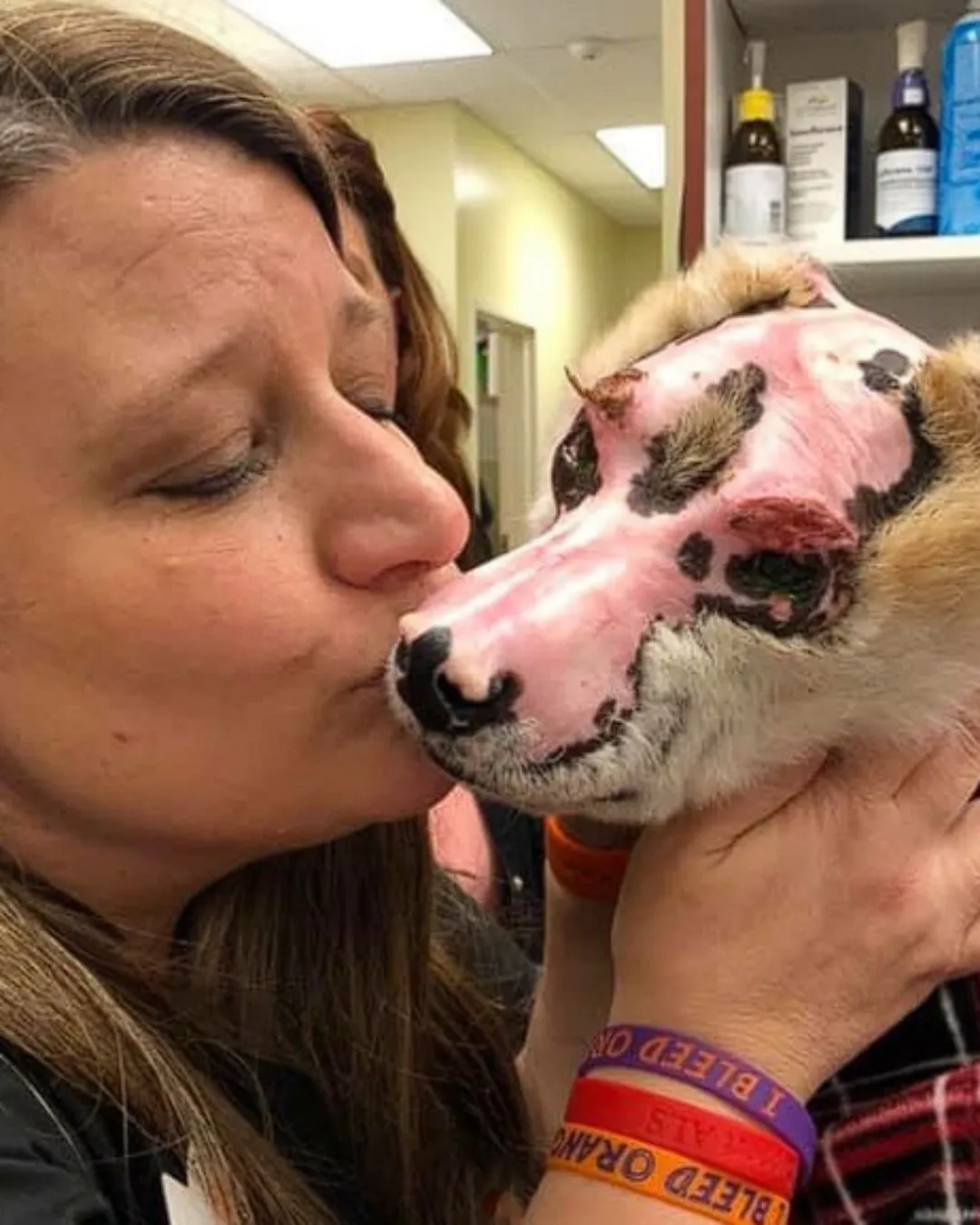
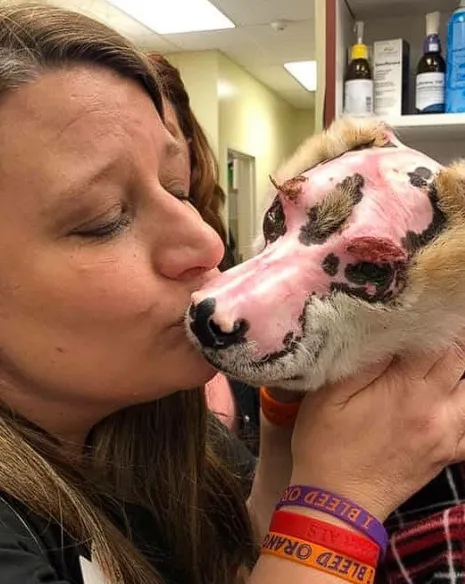
In 2018, in the quiet suburbs of Georgia, a house fire broke out in the middle of the night. Inside was a small Shiba Inu named Taka—a friendly, fox-like dog with bright eyes and an endless love for people. That night, everything changed. Trapped by smoke and flames, Taka cried for help until neighbors rushed to the scene. By the time rescuers reached him, he was barely alive — his body burned, his lungs scorched, and his spirit fading.
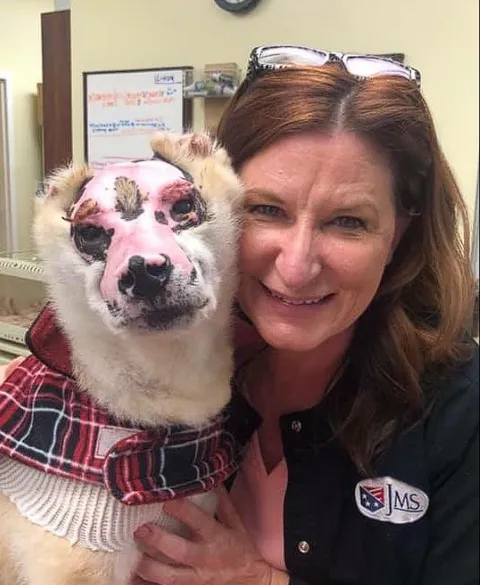
Taka was rushed to the Care More Animal Hospital, where doctors fought to save him. His condition was critical: severe burns covered his face, back, and paws. He had lost most of his fur, and his skin was raw and blistered. Yet, even in agony, when the veterinary staff approached, he wagged his tail weakly — a fragile but unmistakable sign that he hadn’t given up.
Among those who cared for him was Crystal Lesley, a veterinary technician who would soon become the most important person in his new life. From the moment she met Taka, she felt something different — a quiet bond, a spark of resilience that refused to die out. She stayed by his side during every dressing change, every painful procedure, whispering softly, “You’re safe now, buddy. You’re safe.”
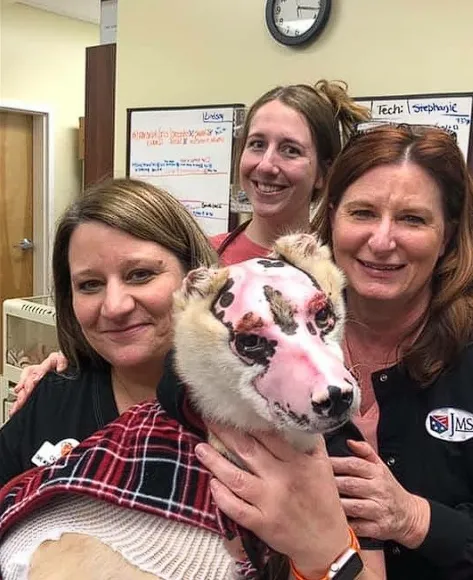
The road to recovery was long and brutal. Taka spent months at the hospital, undergoing surgeries to repair his burned skin and daily treatments to prevent infection. Nights were the hardest — he would whimper in pain, unable to rest. Crystal often stayed late, sitting beside him in the dimly lit treatment room, reading to him or gently stroking his paw until he drifted off. She wasn’t just his nurse. She became his lifeline.
When Taka finally stood on his own again, his reflection told a new story. The burns had left scars — his eyelids were partially fused, his fur would never fully return — but beneath the scars was a survivor. And for Crystal, there was no question of what came next. When Taka’s previous owners couldn’t take him back due to his medical needs, she adopted him. He had already chosen her long before she signed the papers.
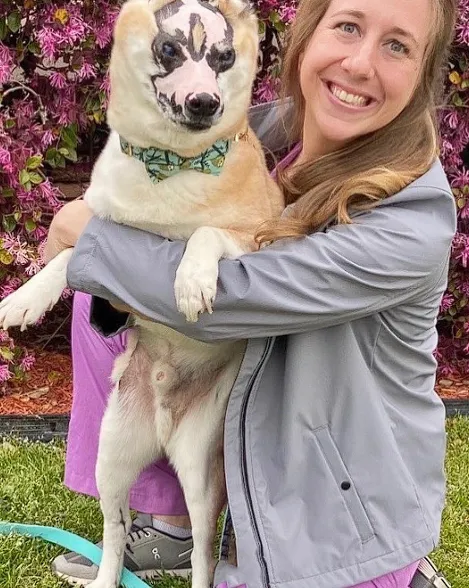
But Crystal saw beyond the scars. She saw strength — a spirit that could inspire others. Together, they began a new journey: Taka’s training to become an AKC-certified therapy dog. At first, it seemed impossible. His face was disfigured; people often stared or turned away. Yet Taka’s gentle nature and resilience soon melted hearts wherever he went. Through months of patient training, he learned to stay calm around strangers, to walk proudly beside hospital beds, and to share comfort with those who needed it most.
His first visit to a burn center was unforgettable. A young patient, wrapped in bandages much like Taka once was, reached out to touch him. The boy hesitated at first, but when Taka leaned forward, resting his head softly on the boy’s arm, something wordless passed between them — an understanding that only survivors share. The room fell silent except for the boy’s quiet whisper: “He’s like me.”
That moment defined Taka’s new purpose. From that day on, he visited hospitals, nursing homes, and therapy centers, spreading hope to those struggling through pain and recovery. He became a living symbol of survival — a reminder that healing is not only about the body but also about the heart.
Crystal often says, “Taka teaches people that beauty isn’t in perfection — it’s in the courage to keep living.” And she’s right. Every scar on his body tells a story, every visit he makes leaves behind a trace of comfort and courage.
Today, years after that terrible fire, Taka walks with a steady stride and a joyful tail wag. Children smile when they see him; burn survivors call him their friend. He may never look like other dogs again, but he has become something far greater — a light for those lost in darkness, a living testament that love and resilience can rebuild what fire tried to destroy.
Taka’s story reminds us that healing doesn’t mean erasing the past — it means transforming it into something powerful, something that can touch lives. From tragedy to triumph, from pain to purpose, Taka proves that even the deepest wounds can become the source of someone else’s hope.