Palinka’s story is one of quiet courage, forced beginnings, and a family’s determination to rebuild life from nothing. She is small, gentle, and still unaware of how much she has already endured. Yet from her very first days, life demanded strength from her that no child should ever have to find.
Palinka was born prematurely, her early arrival triggered not by medical complications alone, but by fear. Her mother was under immense stress after witnessing her husband’s arrest by the police — a moment that shattered any sense of safety their family had left. Just three days later, Palinka was born too soon. What should have been a time of joy became a fight for survival.
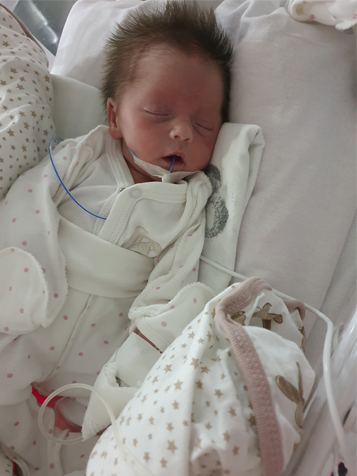
Her birth was difficult, and Palinka spent a long time in the intensive care unit. Machines breathed for her. Doctors monitored every fragile sign of life. It was during those early days that devastating news arrived: Palinka was diagnosed with cerebral palsy, GMFCS level III, along with spastic diplegia affecting all her limbs. The prognosis was uncertain and far from optimistic. Doctors could not say what her future would look like — whether she would walk, speak, or live independently.
For her parents, the diagnosis was only part of the fear. The greater terror was the reality of where they lived. Their home country was no longer safe — not for them, and especially not for a child with complex medical needs. Access to treatment, rehabilitation, and long-term support was uncertain at best. After many sleepless nights and painful discussions, they made a decision no family wants to make: they would leave everything behind and emigrate to protect their children’s future.
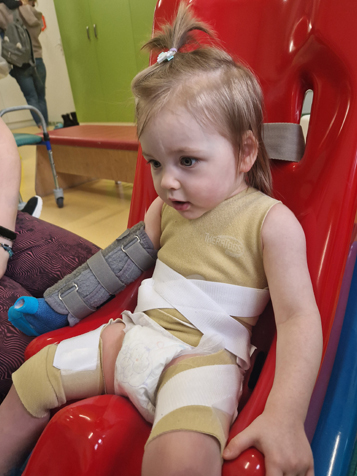
They left their home, their stability, and everything familiar. What they carried with them was fear, hope, and a tiny girl whose life depended on their strength.
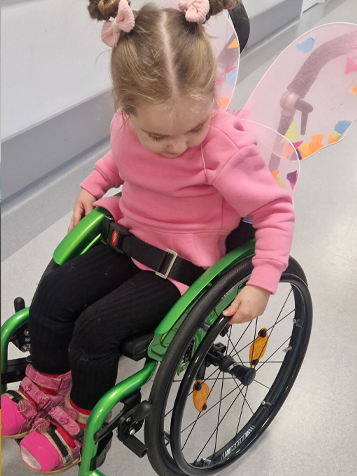
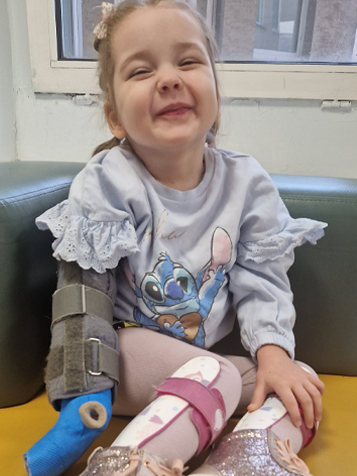
Today, Palinka is three years old. She is bright-eyed, curious, and full of quiet determination. She cannot walk independently yet. She moves with the help of walkers and orthoses, devices that support her small body as she tries to explore the world. She remains under constant orthopedic care because of hip subluxations — a serious complication that can worsen without proper treatment. Doctors also suspect epilepsy, adding another layer of uncertainty to her already fragile health.
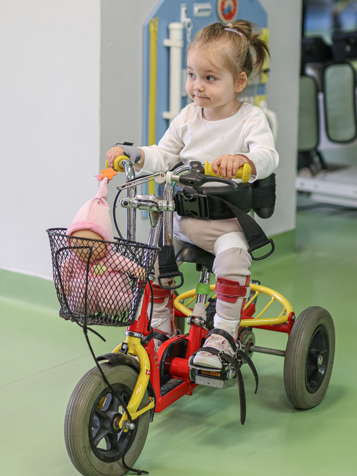
Despite everything, Palinka is extraordinary. She is patient beyond her years, gentle, joyful, and deeply curious about the world around her. She celebrates every tiny success — a better movement, a longer stand, a new exercise completed without tears. Each step forward, no matter how small, is a victory she earns through effort and pain.
Her daily life is filled with rehabilitation. It is not easy, and it is never quick. Palinka currently undergoes therapy using the NDT-Bobath method, along with massages, hand therapy, exercises with a GEO device, and botulinum toxin treatments to reduce muscle spasticity. These therapies are physically demanding and sometimes painful, yet she endures them with a calmness that amazes everyone around her.
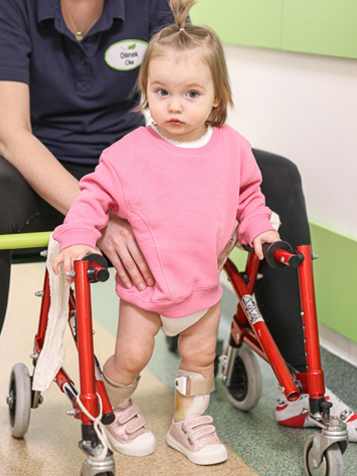
Public rehabilitation alone is not enough. To truly give Palinka a chance at independence, paid rehabilitation sessions are essential. She also urgently needs specialized equipment: a new standing frame to maintain proper posture, day and night orthoses to prevent deformities, and a wheelchair to support her mobility when her strength is exhausted. Each piece of equipment is not a luxury — it is a necessity, a tool that protects her body and preserves her future.
Cerebral palsy is incurable. There is no medication that can erase it. But with regular, intensive, and long-term rehabilitation, there is hope. Hope that Palinka may one day walk independently. Hope that she can move through the world without constant support. Hope that her life will be defined not by limitation, but by possibility.
That hope comes at an enormous cost.
Living in a foreign country is not easy. Palinka’s parents start every day from zero — navigating a new language, a new system, and constant financial pressure. They left everything behind to give their children a future. Some days are filled with tears. Others with exhaustion. But they move forward every single day, because stopping is not an option.
Palinka teaches her parents strength. She teaches them to appreciate the smallest joys — a smile during therapy, a successful exercise, a moment of laughter after a hard day. The road they are walking is long, uncertain, and painfully expensive. Alone, they cannot manage it.
They believe, however, that with help, everything is possible.
One day, Palinka may take her first independent steps. That moment will mean more than walking. It will be proof that love, persistence, and faith can overcome fear, displacement, and illness. It will be the symbol of a family that refused to give up, and of people who chose to help when it mattered most.
Palinka’s journey is far from over. But with compassion, support, and open hearts, it can lead to a future filled with movement, dignity, and hope.
Mary and Yauheni, parents