The year was 1935, and America was on its knees.
The Great Depression had emptied stomachs and pockets alike. Across the Appalachian Mountains, where roads turned to mud and hunger clung like fog, hope was fading fast. The coal mines had gone quiet, factories were shuttered, and families survived on scraps and silence.
But in those dark years, when the nation’s heart seemed to have stopped beating, a quiet army began to move — not with weapons or rations, but with books.
They were called the Book Women.

Most were poor themselves — daughters of miners, young mothers, widows, and farmers’ wives who had known hardship their whole lives. But when President Franklin D. Roosevelt’s New Deal introduced a new project under the Works Progress Administration — the Pack Horse Library Program — they saw a way to serve, to heal, and to give their people something that no hunger could take away: hope through stories.
Each morning before dawn, they saddled up their horses or mules, loading their saddlebags not with food or medicine, but with tattered novels, magazines, almanacs, recipe books, and handmade scrapbooks of clippings and poems. Then, with scarves wrapped around their faces against the cold, they rode out — through
flooded creeks, blizzards, and miles of mountain wilderness.
Some weeks, they traveled as far as 200 miles, through terrain so steep their animals had to be blindfolded to cross. They followed deer paths, forded icy rivers, and knocked on cabin doors so remote that few others ever reached them.
What they brought wasn’t survival in the physical sense — it was something subtler, but just as vital.
To the children waiting barefoot on porches, they brought imagination.
To miners’ wives, weary and hungry, they brought comfort.
To farmers staring at ruined fields, they brought knowledge and the fragile belief that things could one day grow again.
One librarian recalled how children would sprint down rocky slopes when they saw her coming, shouting, “The book lady’s here!” They’d trade their old borrowed titles for new ones, clutching them like treasures. Another told of women who copied recipes from torn magazines, adding their own notes — “use less lard if times are bad” — as though hope could be measured by the spoonful.
In those hills, words became bread for the soul.
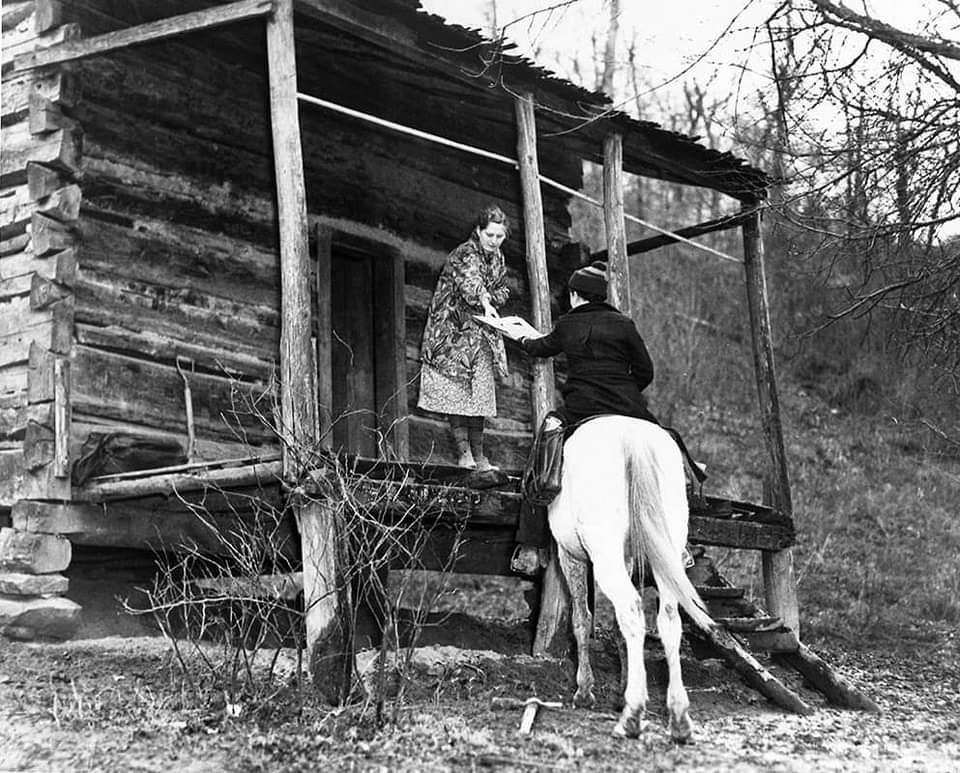
The Book Women didn’t just deliver books; they delivered connection. They taught people to read, wrote letters for those who couldn’t, and sometimes stayed to read aloud to the elderly or the blind. They knew that a good story could light even the darkest cabin, and that education — even if carried by mule — could change a life.
They were paid little, often just $28 a month, and they risked everything — frostbite, floods, snakebites, even death — for a mission that most of the country never heard about. Yet they rode on, week after week, fueled by faith that stories mattered.
By 1943, the world had changed again. America was at war, and the Pack Horse Library program came to an end as funds were redirected to the war effort. But by then, the Book Women had achieved something extraordinary.
They had delivered more than 100,000 books to 100,000 people — across some of the most isolated communities in the United States. In those rugged hills, literacy rose, children dreamed beyond the coal mines, and families found in words the one thing poverty could never strip away: dignity.
When people speak of the Great Depression, they often speak of its despair — of breadlines and broken dreams, of dust and hunger. But there was another story too, one written not in headlines, but in the footprints of women who rode through storms with saddlebags full of light.
They weren’t just librarians.
They were teachers, healers, and keepers of hope. They carried courage in their bones and compassion in their hearts, proving that even in the harshest winters of history, kindness could still ride.
Today, their legacy endures in the libraries of Appalachia, in every child who learns to read, and in every person who finds solace in a book when life feels too heavy to bear.
They called them “the Book Women.”
But they were something greater — they were lifelines.
And though their hoofprints have long faded from the mountain trails, the echoes of their mission remain, whispering through time:
Even in the hardest of days, stories can save us.