Before the night that changed everything, Abram Raglin was exactly what a three-year-old should be. He was loud in the way only happy children are, full of motion, questions, and the kind of laughter that fills every corner of a house without asking permission.
Dinosaurs were his favorite thing in the world. He knew their names, their roars, their sizes, and their imagined personalities, and he carried them with him everywhere, turning couches into mountains and hallways into prehistoric jungles.

To his family, Abram was more than a child. He was rhythm and routine, the reason mornings started early and nights ended with stories read twice because once was never enough.
Life felt ordinary in the best way. Busy, imperfect, but safe.
And then one night, safety disappeared.
It was late when Abram’s mom checked on him, expecting nothing more than a peaceful sleeping child. What she found instead is a moment no parent ever forgets, no matter how many times they try to bury it.
Abram was seizing. His body moved in ways it shouldn’t, stiff and uncontrolled, and his breathing sounded wrong, shallow and panicked, like air was something he could no longer reach on his own.
Time fractured instantly. Seconds felt endless. Fear moved faster than thought.
His mom grabbed him, calling his name, willing him to come back to her, while dialing for help with hands that shook so badly they barely obeyed her.
By the time paramedics arrived, Abram’s body had already been through more trauma than any three-year-old should ever experience. He was rushed to the hospital as his family followed behind, hearts pounding, minds unable to form words beyond one silent plea: please let him live.
In the emergency room, everything happened at once. Doctors surrounded his small body. Machines beeped. Voices overlapped. Acronyms and medical terms filled the air, none of them comforting.
Abram struggled to breathe. His oxygen levels dropped. His brain had been deprived of air during the seizure, and no one yet knew how much damage had been done.
Then came the diagnosis that would shatter what little certainty remained.
HLH.
Hemophagocytic Lymphohistiocytosis.
A rare, aggressive, life-threatening condition where the immune system goes into overdrive, attacking the body itself. A disease so uncommon that many doctors never see a case in their entire careers.
For Abram, it had come without warning.
The inflammation stormed through his tiny body, triggering the seizure, compromising his breathing, and leaving behind a devastating brain injury that would change everything.
In a matter of hours, the joyful dinosaur-loving toddler was fighting for his life.
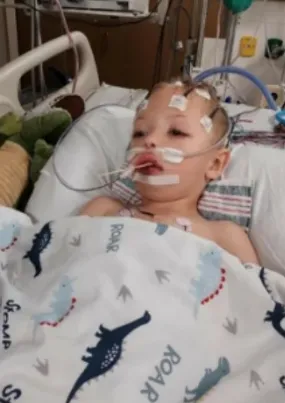
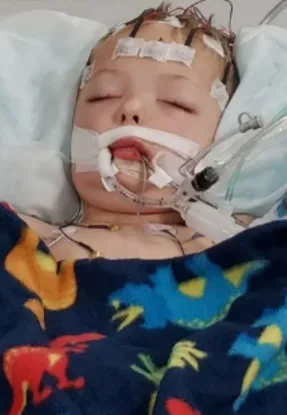
Those first days blurred together in the ICU. Abram lay surrounded by tubes, wires, and machines that did the work his body no longer could on its own.
His parents learned how to read monitors instead of storybooks. They learned the sound of alarms, the meaning of numbers, the weight of waiting.
Doctors spoke carefully, choosing words that balanced honesty with hope. They explained the severity of HLH, the risks, the treatments, the unknowns that stretched endlessly into the future.
They talked about brain injury. About possible outcomes. About things Abram might never do again.
His family listened, nodded, asked questions, and then cried when they were alone.
There were moments when it felt impossible to breathe, moments when the fear was so heavy it pressed down on their chests like a physical force.
But Abram stayed.
Day after day, he stayed.
Treatment was aggressive. Medications to calm his immune system. Support for his breathing. Constant monitoring to keep his body stable enough to fight.
Slowly, the storm inside him began to quiet.
But survival was only the first step.
When Abram finally woke, he was not the same little boy who had gone to sleep days earlier. The brain injury had taken things from him—movement, coordination, abilities that once came naturally.
Recovery was not a straight line. It was a series of tiny, exhausting steps forward, often followed by setbacks that felt cruel in their timing.
Therapies filled his days. Physical therapy to teach his body how to move again. Occupational therapy to help him relearn basic skills. Speech therapy to rebuild communication.
Progress came in fragments. A small movement. A longer moment of focus. A flicker of recognition in his eyes.
Each milestone was celebrated like a miracle, because in many ways, it was.
Abram’s strength became the quiet anchor holding his family together. Even on days when progress stalled, even when exhaustion threatened to swallow everyone whole, he kept trying.
There was no anger in him. No resentment. Only effort.
But effort alone does not erase barriers.
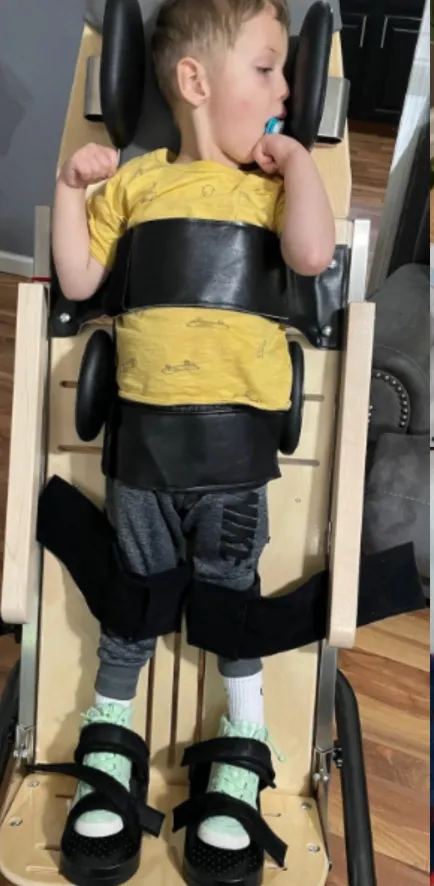
As Abram’s needs became clearer, his medical team recommended a specialized therapy device—one designed to support neurological recovery, help retrain movement, and give his brain the best possible chance to heal.
It was not a luxury. It was a tool that could change the trajectory of his recovery.
And then insurance said no.
The denial came in a letter filled with bureaucratic language that felt detached from reality. It did not acknowledge Abram’s fight, his diagnosis, or the urgency of his situation.
It simply said the device was not covered.
For his family, it felt like another blow in a long series of them. They had survived the night they almost lost their son. They had endured the ICU. They had learned how to navigate a world forever altered.
And now, a piece of paper was standing between Abram and a chance at more progress.
They appealed. They made calls. They sent records. They explained, again and again, why this mattered.
The answer did not change.
It was a familiar frustration for families living in medical limbo, where survival does not guarantee support, and healing comes with a price tag few can afford.
For a moment, it felt like the road ahead was narrowing, hope shrinking under the weight of yet another obstacle.
And then something unexpected happened.
Someone heard Abram’s story.
Someone saw past the diagnosis and the denials, past the paperwork and the limitations, and saw a little boy who had already beaten impossible odds.
An act of kindness arrived not as words, but as action.
The therapy device was gifted to Abram.
No conditions. No caveats. Just generosity.
For his family, it was overwhelming in the purest sense of the word. Relief and gratitude collided in a way that left them speechless.
This was not just a piece of equipment. It was possibility.
It was time. It was opportunity. It was someone saying, “Your child matters, even when systems fail you.”
When Abram began using the device, something shifted.
Progress did not suddenly become easy, but it became more visible. His movements grew stronger. His control improved. His confidence blossomed in ways that surprised even his therapists.
Each session was still work. Hard, tiring work.
But it was work that led somewhere.
Abram’s family watched him engage with the world again, finding joy in effort, pride in achievement, and curiosity in his own abilities.
Dinosaurs returned to his play. Not as they were before, but as they are now—adapted, imaginative, resilient.
The gift did not erase the trauma of that night. It did not undo the brain injury or the months of fear that followed.
But it changed the direction of the path ahead.
It reminded Abram’s family that even in the most fragile moments, kindness can arrive unannounced and alter everything.
Today, Abram’s recovery continues. It is still slow. It is still challenging. There are still unknowns waiting down the road.
But there is also hope grounded in reality, built not on denial of hardship, but on proof of progress.
Abram is still here.
He is still trying.
And because of one unexpected act of generosity, he has been given a little more room to grow, to heal, and to reclaim pieces of the life that was almost taken from him.
His story is not just about survival. It is about the spaces where medicine ends and humanity steps in.
It is about how close his family came to losing him, and how fiercely they now fight for every ounce of progress.
And it is about a little boy who faced death before he understood what it was, and who now continues forward, one determined step at a time, carrying both the weight of what he survived and the promise of what is still possible.