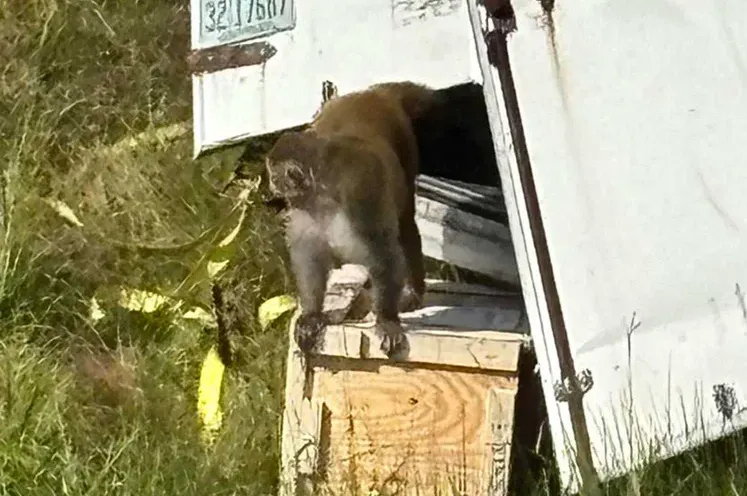
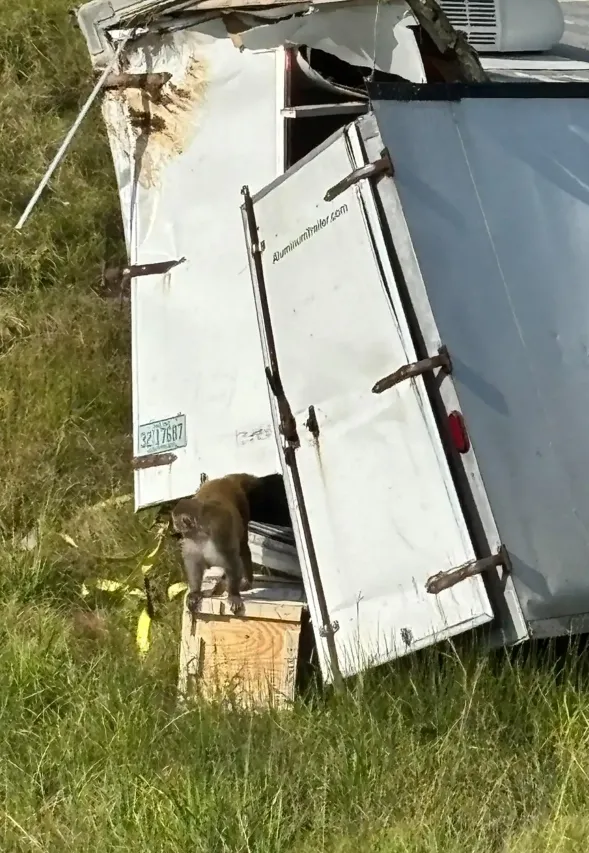
In the pale morning light of October 28, 2025, Highway I-59 in Mississippi looked like any other stretch of Southern asphalt — long, quiet, and wrapped in mist. But within moments, that calm would be shattered by chaos. A transport truck carrying twenty-one rhesus macaque monkeys to a biomedical research facility overturned near Heidelberg, sending wooden crates tumbling across the road, and animals — terrified and confused — scattering into the woods.

It would become one of the most unusual and emotionally charged rescues the state had ever seen.
And at the heart of it was one frightened little monkey who refused to be caught.
A Crash That Changed Everything
According to the Mississippi Department of Wildlife, Fisheries, and Parks (MDWFP), the crash happened shortly after sunrise. Witnesses recalled the screeching of tires, the splintering sound of wood, and a sudden flurry of movement — small brown shapes leaping across the median and vanishing into the pine forest beyond.
At first, motorists didn’t even realize what they were seeing.
“Someone shouted, ‘Those are monkeys!’” said a driver who stopped to help. “I thought maybe it was a prank — until I saw the crates on the road.”
Emergency responders soon arrived to find a scene that was both heartbreaking and surreal: overturned cages, broken boards, the smell of diesel, and frightened animals clinging to anything they could.
Five monkeys had died instantly in the crash. Others cowered, trembling, while a few sprinted into the trees. Officers and wildlife specialists rushed to contain the chaos, knowing that these were not wild animals — they were research subjects, accustomed to human care but now thrust into a world of noise, fear, and confusion.
Fear and Misunderstanding
Word spread quickly through the small Mississippi towns nearby: “Monkeys on the loose.”
Within hours, social media lit up with photos and rumors. Some claimed the animals were diseased. Others feared they might attack pets or children. Panic, mixed with fascination, took hold.
Two of the escaped monkeys were tragically shot by residents who said they acted out of fear. One mother of five told reporters, “I just wanted to keep my kids safe. I didn’t know if those things could be dangerous.”
But the truth, later confirmed by officials, was very different. The monkeys were healthy, disease-free, and being legally transported by a biomedical company, PreLabs LLC, to a licensed research facility. They posed no threat.
By then, however, the damage — both emotional and physical — was done. Seven monkeys were dead. Fourteen remained missing in the dense forest that bordered the interstate.
The Search Begins
For the next week, Mississippi became the backdrop of an extraordinary search effort — a blend of science, compassion, and sheer determination.
Wildlife officers set up motion-activated cameras, bait traps, and night-vision patrols. Helicopters with thermal imaging scanned the woods. Local residents were urged to call a special hotline if they spotted anything unusual.
The community, despite its fear, began to rally together. Farmers offered access to their land. Truckers volunteered to deliver supplies to the search sites. Children drew pictures of monkeys with messages like “Please come home!” taped to store windows.
It wasn’t just about recovering animals anymore. It was about redemption — about doing the right thing after the initial tragedy.
“We owed it to them,” said MDWFP officer Craig Sanders, who led the recovery. “They didn’t choose to be there. They were victims of circumstance.”
Moments of Hope
On the third night after the crash, a wildlife team captured the first of the missing monkeys near a creek. She was dehydrated, trembling, but alive. “She looked at us like she wanted to trust again,” one rescuer recalled. “She didn’t resist — she just looked so tired.”
Over the next few days, several more were found. Some were hiding near barns, others had taken refuge high in trees, their eyes reflecting in flashlights like tiny stars.
Each recovery brought a small wave of relief — but also a sobering reminder of how fragile these creatures were. They depended on people for food, for care, for safety. Out in the wild, even for a few days, the odds were cruel.
And yet, there was one monkey no one could find — the smallest of the group, a young male that rescuers began calling “Scout.”
The Last One
Scout had somehow managed to evade every search team. He was spotted twice on motion cameras but always vanished before help arrived. For days, his tiny footprints appeared along fences and backyards, then disappeared again into the woods.
“He was smart,” said Sanders. “You could tell he was scared, but also cautious. He wasn’t just running — he was surviving.”
As the week dragged on, fatigue set in. Rain soaked the woods, and temperatures dropped. Some began to fear Scout might not make it.
Then, on the seventh morning, a call came in to the hotline. A man from Jasper County said he’d seen something “like a small child in brown fur” near his property. Officers raced to the scene.
They found Scout clinging to a tree branch, thin and shaking, his fur matted with mud. When they approached, he didn’t flee. He just stared — wide-eyed, exhausted, but alive.
A wildlife technician raised a tranquilizer dart, whispered a prayer, and fired. Moments later, Scout was gently lifted into a carrier and wrapped in a warm blanket.
The entire rescue team cried.
“It’s hard to explain,” said Sanders. “After everything — the deaths, the fear, the misunderstanding — seeing that little guy safe again… it felt like closure. Like maybe we’d made something right.”