When Sarah Mitchell was thirty-one weeks pregnant with her first child, she thought the worst thing she was facing was a migraine.\

She had always been prone to headaches, but this one was different — sharp, blinding, relentless. During a routine appointment, a close family friend who had accompanied her noticed something else. Sarah’s stomach was tightening rhythmically.
Within minutes, she was sent to her obstetrician. The contractions were one minute apart.
What began as a migraine became a hospital admission at Baptist Medical Center in Jacksonville. Sarah and her husband, Daniel, still believed they were weeks away from meeting their son. They had painted the nursery pale blue. They had argued playfully over baby names before settling on Noah James Mitchell. They had imagined the ordinary joys of first-time parents.
Instead, they were told something was wrong.
Hours blurred into days of tests. At first, there were murmurs of uncertainty. Then came misinterpretations. Finally, maternal-fetal specialists delivered the words that would fracture their world: congenital diaphragmatic hernia.
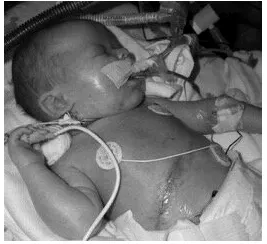
CDH.
They had never heard the term before.
Doctors explained that a hole in Noah’s diaphragm had allowed abdominal organs to shift into his chest, preventing his lungs from developing properly. Their local hospital was not equipped to handle such a case. If Noah were delivered there, he would be the first infant treated with ECMO at that facility.
The weight of that reality settled heavily.
They were referred to Dr. David Kays in Gainesville. The appointment was scheduled for the next day.
After meeting him, everything changed.
Sarah was told she could not return to Jacksonville. The risk of delivering elsewhere was too high. If Noah were born and required transport, he might not survive the transfer. They needed to stay near Gainesville.
The diagnosis: right-sided CDH.
Right-sided cases are often more complex.
Yet Dr. Kays spoke not in absolutes, but in possibility. His survival rates gave them something they had not felt in days — a fragile thread of hope.
The next six weeks were a battle of endurance.
Sarah was admitted repeatedly with contractions. Her blood pressure spiked. She returned to labor and delivery more times than she could count. Each time, she feared it was the moment Noah would arrive before he was ready.
During one prenatal appointment, doctors found fluid around Noah’s heart. Sarah remembers the silence in that room.
She remembers gripping Daniel’s hand.
They called their church. They asked friends and family to pray.
At the next ultrasound, the fluid was gone.
Pain had already carved deep lines into their hearts. Fear lingered constantly, like a shadow that would not lift.
Noah was delivered by cesarean section at thirty-seven weeks.
Sarah has said she had never seen so many medical professionals in one room. Neonatologists, respiratory therapists, nurses, surgeons — an army waiting for one tiny life.
He cried briefly before being intubated.
Within moments, he was transferred to the NICU.
The first night passed in a blur of machines and whispered medical conversations. By the second day of life, Noah’s condition worsened.
He was placed on ECMO.
Extracorporeal membrane oxygenation — a machine that takes over the work of heart and lungs. Blood leaves the body, is oxygenated externally, and returns. It is used when survival without it is unlikely.
Sarah will never forget signing Noah’s birth certificate when Dr. Kays entered her hospital room.
“He’s just being stubborn,” he said gently. “He’s not responding the way we hoped.”
Stubborn.
It was a word she clung to.
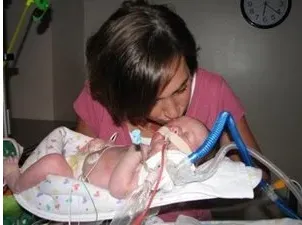
Noah remained on ECMO for six long days. Every hour carried risk — bleeding, infection, neurological injury. Sarah sat beside him, watching crimson blood cycle through plastic tubing, praying that his tiny lungs would strengthen enough to take over.
At nine days old, he underwent surgical repair.
Inside the operating room, doctors discovered his condition was more severe than originally predicted. A protective sac had limited some of the displacement, but damage was extensive. In the end, Noah was left with only half of his right lung and about eighty percent of his left.
Those numbers should have defined his limits.
Instead, they became the starting point of his fight.
The days following surgery were cautious. Ventilator settings were adjusted gradually. Oxygen requirements fluctuated. There were moments when progress stalled, when alarms sounded too long.
But Noah improved.
ECMO was discontinued. He transitioned from full ventilator support to less invasive breathing assistance. Eventually, he was stable enough to move to a step-down unit within the NICU.
After more than a month in intensive care, Noah was discharged home on supplemental oxygen.
Walking out of the hospital felt surreal.
Sarah had entered Baptist weeks earlier with a migraine. She left Gainesville with a child whose life had hung in balance more times than she could count.
Home life brought new challenges — oxygen tubing, pulse oximeters, constant monitoring. Every cough sparked anxiety. Every minor illness felt monumental.
But Noah grew.
His lungs expanded as much as they could. His heart remained strong. Developmental milestones came steadily, if not always easily.
Pain had introduced his story.
Fear had shaped his beginning.
Setbacks — fluid around the heart, ECMO, severe lung compromise — had threatened to define him.
Endurance carried him through nights in the NICU and weeks tethered to machines.
Hope emerged slowly, like sunrise after a relentless storm.
By age three, Noah had a baby brother — healthy and strong. Sarah remembers watching Noah lean over the bassinet, curiosity bright in his eyes. The boy who once needed machines to breathe was now a big brother.
Today, nearly ten years old, Noah is energetic and full of personality.
He draws constantly. He writes imaginative stories. He plays sports with determination that surprises even his parents. He runs across fields, laughs loudly, and rarely allows his medical history to slow him down.
Strangers would never guess that he once survived with only half a lung on one side.
They would not see ECMO tubing or surgical scars in the sunlight.
But Sarah and Daniel see it every day.
They see resilience in his humor.
They see gratitude in his joy.
They see the fragile thread of hope that carried them through their darkest hours.
Noah James Mitchell is not simply a CDH survivor.
He is a testament to what happens when expertise, faith, and relentless parental love converge in the face of terrifying odds.
And for families standing in hospital rooms today, hearing the same diagnosis for the first time, his story whispers something powerful:
Pain may begin the journey.
Fear may walk beside you.
Setbacks may test your strength.
But hope — real, stubborn hope — can still win.