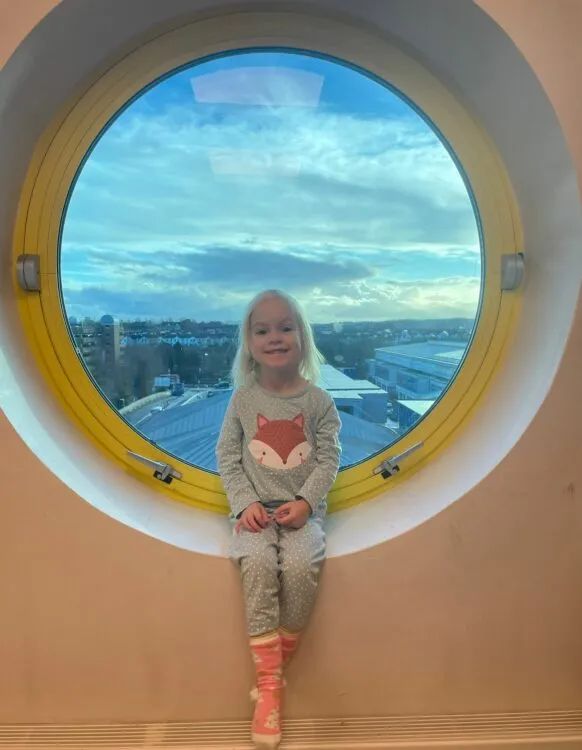
Three-year-old Tilly is one of life’s little sparks. She has an infectious laugh, a fearless curiosity, and a smile that can light up an entire room. Even now—surrounded by hospital walls instead of playgrounds—her joy has a way of breaking through. She is the kind of child who reminds everyone around her what childhood is supposed to look like, even when her own has been interrupted far too soon.

Tilly is a triplet, the only girl among twin brothers Arthur and George. From the very beginning, she held her own—bold, determined, and full of personality. Last summer, however, her mum Liz began to notice something small that didn’t quite sit right. Tilly had developed a slight limp. It came and went, sometimes barely noticeable, sometimes enough to pause Liz’s heart for just a second longer than normal.
At first, it didn’t seem alarming. Children stumble. Toddlers limp for a day or two and then bounce back. Life carried on. That September, Tilly started school, stepping into a new chapter just like her brothers. Her appetite dipped a little, and she lost some weight, but she was still smiling, still laughing, still very much herself.
By Christmas, though, the limp had worsened.
Liz had tried to rationalise her fears, telling herself it was normal parental worry, the kind that comes with raising three young children at once. But deep down, she knew something wasn’t right anymore. The feeling refused to leave. Early in the new year, Tilly was referred for an x-ray. Around the same time, new symptoms appeared—complaints of pain, night sweats that soaked her sheets. Small signs that, when placed together, painted a picture Liz could no longer ignore.
Not long after the x-ray, the hospital called with urgent questions.
Had Tilly been in a car accident?
A rollercoaster?
Anything involving high impact?
The scans looked like a fractured hip.
Over the following days, everything moved quickly. Blood tests. MRI scans. More waiting rooms. More unanswered questions. Then Liz and her husband Stuart were called into a side room at the hospital. Liz remembers the moment clearly. She turned to Stuart and said, quietly but with certainty, “I think this is going to be bigger than we thought it was going to be.”
She was right.
The scans revealed lesions on Tilly’s hip—but that wasn’t the worst of it. Doctors also found a primary tumour on her left kidney. It was the size of a grapefruit. On January 9th, just days later, Liz and Stuart were given the news no parent is ever prepared to hear.
Tilly had high-risk stage 4 neuroblastoma.
Liz remembers seeing the scans for the first time. The tumour took up so much space on Tilly’s tiny body that it barely seemed possible. “Given how little she was,” Liz said, “it was frightening.”
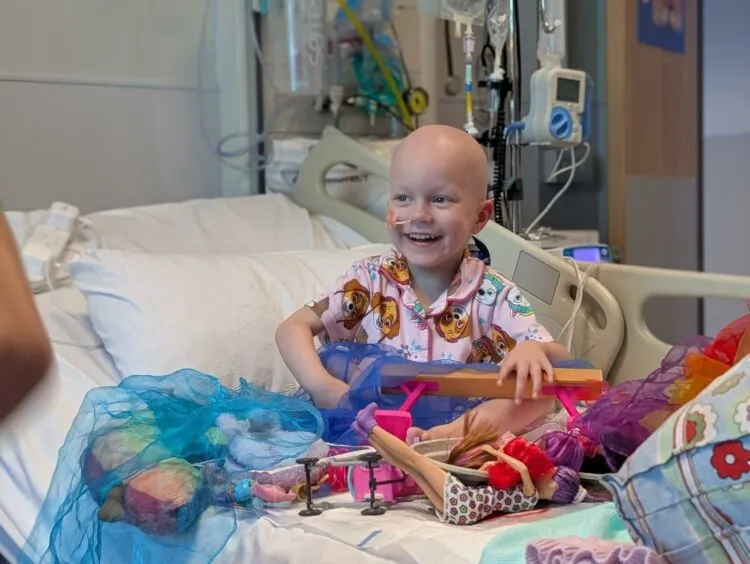
There was no time to process. No time to ease into the reality. That very afternoon, Tilly began eight gruelling rounds of chemotherapy. Each round lasted ten days. Eight rounds meant eighty days in total. She became an inpatient almost immediately. Childhood, as the family knew it, stopped.
Tilly was separated from her brothers.
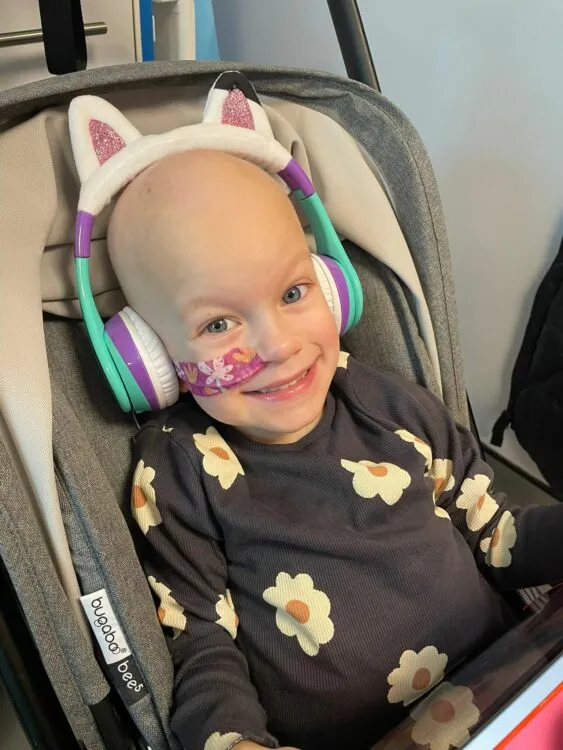
Suddenly, life split in two. Liz stayed in hospital with Tilly, navigating medications, procedures, and long nights on Rainbow Ward at Noah’s Ark Children’s Hospital for Wales, while Arthur and George stayed at home with their dad. The boys missed their sister desperately. Tilly missed them just as much. For the first time in their young lives, the triplets were apart.
In April, surgery removed 95% of the tumour. But a small part had to remain—it was too close to a major artery to be removed safely. Even good news came with limits. After surgery, Tilly went on to complete high-dose chemotherapy and received a stem cell transplant, another enormous step in a journey that never seemed to slow down.
More than 150 days have passed since Tilly’s diagnosis.
One hundred and twelve of those days have been spent in hospital.
Despite the clinical environment, the team on Rainbow Ward do everything they can to preserve Tilly’s childhood. Sparkle coordinator Emily makes sure special moments don’t disappear just because life looks different now. Mother’s Day is still celebrated. Pancake Day still happens. Small joys still matter.
The play team has become a lifeline. During long stretches of isolation, they help keep Tilly entertained, engaged, and smiling. Play specialists Allison and Catrin play a crucial role in preparing Tilly for procedures that could otherwise feel terrifying for a three-year-old. Using age-appropriate play, they explain what’s going to happen, helping Tilly feel less scared and less out of control in a world that often moves too fast for her to understand.
Next month, Tilly will travel to London for proton beam therapy. It will last a month, with daily sessions that require a general anaesthetic each time. Just ten days after that ends, she will begin six months of immunotherapy. Her treatment journey will stretch into January—one full year since the day cancer entered her life.
It is a long road. An exhausting one. A road no three-year-old should ever have to walk.
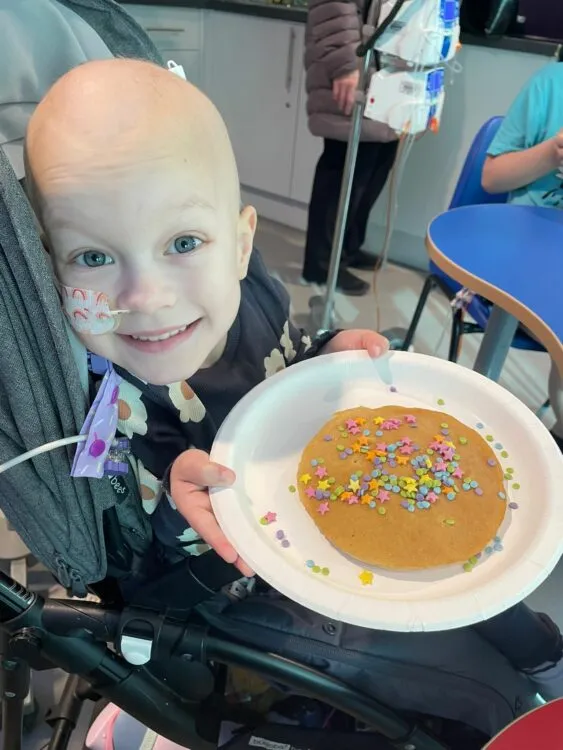
And yet, Tilly still laughs.
Liz says, “Despite it all, Noah’s Ark is such a special place. The teams truly go above and beyond for your child and the whole family. When Tilly is well enough, it’s so nice to have the boys here too—to feel like a family again.”
That is what this fight has taken—and what it continues to give back in moments. Family time. Laughter in hospital corridors. A little girl who refuses to let cancer steal her spark.
Tilly’s story is not just about illness.
It is about separation and resilience.
About fear and fierce love.
About a childhood interrupted—but not erased.
She is still one of life’s little sparks.
And she is still shining.