In the depths of Kenya’s Rumuruti Forest, beneath the towering trees and through the thick underbrush, a young elephant named Simotua faced a fate no one could have foreseen.

Just one year old, with the world ahead of him, his life was brutally interrupted by the cruelty of poachers. It was a day that would change everything for the tiny elephant.

The Tragic Encounter
The forest was quiet that morning, the rustle of leaves the only sound as Simotua wandered with his herd, unaware of the danger lurking nearby. His world was still simple and full of wonder—nibbling on leaves, exploring the boundaries of his little world, and staying close to his mother. But in an instant, that world came crashing down.
Poachers, seeking to profit from the ivory trade, had set a snare—a metal trap designed to capture and maim animals. The poachers’ intentions were cruel, but their method was insidious. The young elephant, with his curiosity and innocent steps, wandered too close and fell victim to the trap. The snare caught his leg, pulling him down with a sickening snap.
In his frantic struggle to free himself, Simotua only made things worse. He was trapped, helpless, and in agony. As the poachers returned to check on their snares, they discovered the injured elephant. Instead of mercy, they inflicted further harm, stabbing him with a spear to ensure he couldn’t escape. Left alone in the forest, his blood mingling with the dirt and leaves, Simotua lay there, crippled and broken, his body a painful reminder of the viciousness that humanity can inflict on the innocent.
The world seemed to have turned its back on the young elephant. But fate had other plans.
A Rescuer’s Call
Hours passed, and it seemed like hope was slipping away from Simotua’s fragile existence. However, in the midst of the cruelty, there was a glimmer of kindness. The sounds of a helicopter soon pierced the silence of the forest, a sign that help was on the way. Rescuers from the David Sheldrick Wildlife Trust (DSWT), a team renowned for their work in saving and rehabilitating elephants, had been alerted about Simotua’s plight. They had heard his cries echoing through the forest and knew they had to act quickly.
The team arrived at the scene with urgency. As they approached the young elephant, they found him barely conscious, his leg mangled and his body weak from blood loss and the trauma he had endured. It was a heartbreaking sight—this innocent creature, so young, yet already scarred by the violence of humans.
Without hesitation, the DSWT team carefully freed Simotua from the snare, lifting him gently onto a stretcher. Every move was calculated to avoid further injury, knowing that the elephant’s survival depended on swift and expert care. A team of veterinarians and wildlife experts had already prepared a plan to save his life. As they lifted him into the helicopter, they whispered words of hope, knowing that this young elephant’s journey had only just begun.
The Healing Begins
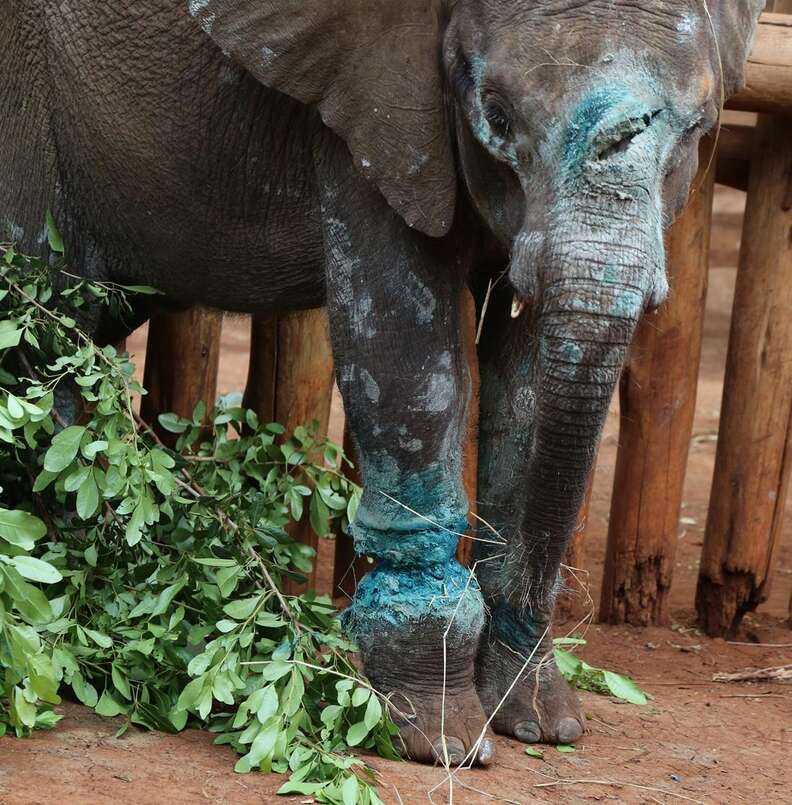
Simotua was flown to Nairobi National Park, where the DSWT’s Nairobi Nursery would be his sanctuary for the weeks to come. Upon arrival, the medical team sprang into action. His wounds were cleaned and treated for infections, and his leg was carefully bandaged. The severity of his injuries left no doubt that his survival would be a miracle. But even amidst the pain and uncertainty, Simotua’s spirit never wavered.
He was placed in a special recovery area where he could rest and begin his long journey toward healing. The team worked tirelessly to monitor his condition, ensuring that the elephant’s physical wounds were treated while also providing him with the emotional care he so desperately needed. It was clear that this young elephant had endured unimaginable pain, but his will to live was undeniable.
Weeks passed, and while his body slowly began to heal, the real challenge was getting Simotua to trust again. For an elephant, the bonds they share with their herd are sacred. In a strange and unfamiliar environment, it was important for him to feel safe and supported. At first, Simotua remained withdrawn, his once-spirited eyes clouded with pain. But soon, he was introduced to other orphaned elephants, each one a symbol of survival and strength.
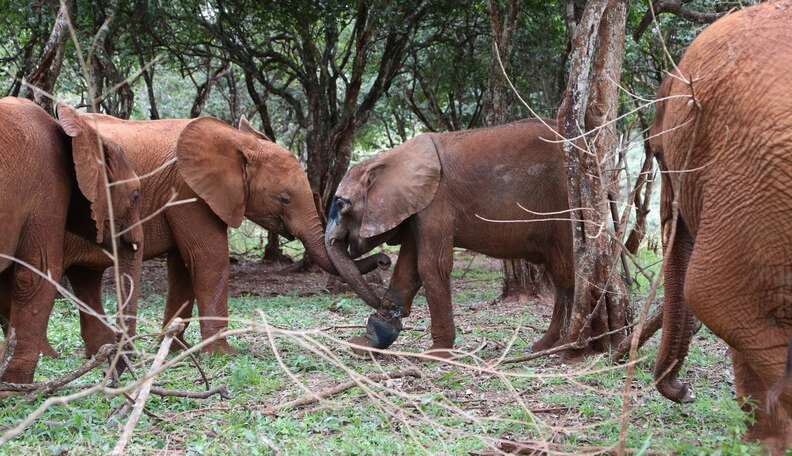
Simotua’s first interaction with his new companions was tentative. He stood at a distance, watching the other elephants as they played and interacted. Then, slowly, another elephant named Kiasa approached him. Kiasa, a much older and more experienced elephant, reached out with her trunk, gently touching Simotua’s face. It was a simple gesture, but to Simotua, it was everything. His body seemed to relax for the first time since his rescue, as though Kiasa’s touch had reassured him that he was no longer alone.
Over time, Simotua began to open up. He joined the others in their play, chasing them around the sanctuary and trying to catch up with their quick movements. Though his steps were initially slow and cautious, each day he grew stronger, and his spirit began to return. The team marveled at his progress, knowing that his recovery would not only be physical but also emotional.
A Journey of Healing and Hope
Simotua’s story is a testament to the power of resilience. His journey from the brink of death to recovery was nothing short of miraculous. But it was also a reminder of the cruelty that still exists in the world. The poaching of elephants for their ivory continues to devastate populations across Africa. Every day, elephants are killed for their tusks, their lives stolen by greed. But Simotua’s story also shows the incredible power of compassion and the hope that can emerge from even the darkest places.
As Simotua grew stronger, the DSWT team began to plan for his future. The goal was always to return him to the wild, where he could roam free and live the life he was meant to. But they knew that before that could happen, Simotua would need time. He needed to heal both physically and emotionally, and he needed to learn to trust again. His story wasn’t just about survival—it was about rebuilding a life that had been shattered by the cruelty of humans.
With every passing day, Simotua’s story became one of hope, not just for him but for all elephants who face the horrors of poaching. As his strength returned, so did his playfulness. He would chase his fellow orphans through the grass, his small body moving with increasing speed and confidence. The sanctuary was filled with joy and laughter as the young elephant rediscovered his joy for life.
The team at DSWT knew that Simotua’s future was bright. One day, he would walk free again in the wild, alongside other elephants who had also been rescued from the brink of death. But for now, he remained in the safety of the sanctuary, surrounded by love and care, his wounds healing and his heart mending.
A Future of Freedom
Simotua’s story is more than just one elephant’s recovery—it’s a call to action for all of us. It reminds us of the power of compassion and the importance of wildlife conservation. Every day, organizations like the David Sheldrick Wildlife Trust work tirelessly to protect and rehabilitate elephants like Simotua, but they can’t do it alone. The fight against poaching is far from over, and it will take all of us working together to ensure that elephants have a future in the wild.
Simotua’s story shows us that even in the face of unimaginable cruelty, love and kindness can heal the deepest wounds. It is a story of survival, yes, but it is also a story of hope. For Simotua, the future is bright. He may have been broken, but he will rise again, stronger and free.
And one day, when he finally returns to the wild, he will carry with him not just the scars of his past, but the promise of a future where elephants can roam free, safe from the greed and violence that once threatened to steal their lives.
Join the Movement
To support elephants like Simotua and help ensure their survival, consider making a donation to the David Sheldrick Wildlife Trust or volunteering with a wildlife conservation organization. Every action, no matter how small, helps protect these incredible creatures and the future of our planet.