Becky and her partner walked into that appointment hopeful and calm, unaware that a single scan was about to change the course of their lives forever.
In one quiet moment, certainty gave way to fear.

The ultrasound revealed something unexpected.
Doctors noticed abnormalities in Iris’ heart structure and gently explained that further investigation was needed.
Soon, the words tetralogy of Fallot were spoken—a severe congenital heart condition affecting how blood flows through the heart and to the lungs.
It was a diagnosis that shattered the illusion of a carefree pregnancy.
Tetralogy of Fallot meant that Iris’ heart would not be able to oxygenate her blood properly without medical intervention.
It meant surgery—almost certainly.
It meant uncertainty, waiting, and a future filled with medical appointments instead of simplicity.
For Becky and her partner, the joy of expecting a child was instantly entangled with fear.
The days that followed were overwhelming.
They searched for information, tried to understand complex medical explanations, and learned a vocabulary no parent ever wants to know.
Every heartbeat on a monitor suddenly felt fragile.
Every movement in Becky’s womb became a reassurance that Iris was still fighting.
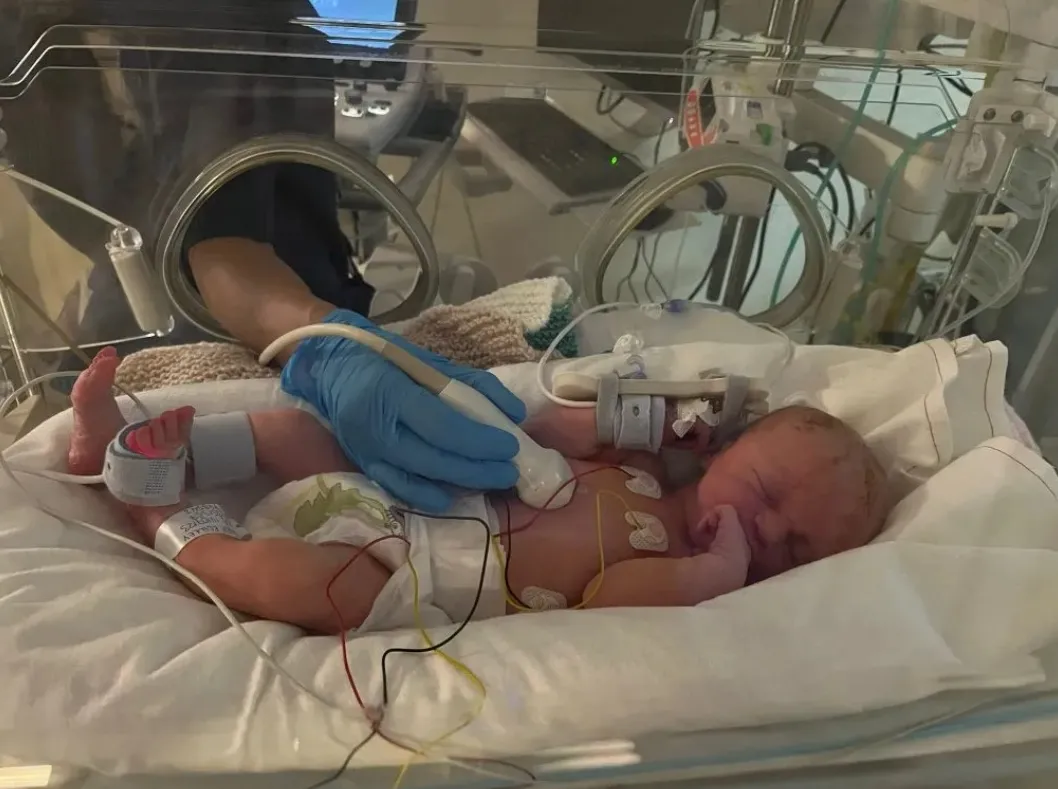
During that time, Becky found support through Tiny Tickers.
Connecting with others who had walked a similar path brought comfort in a moment that felt incredibly isolating.
Stories of children who had survived, thrived, and grown gave her something priceless—hope.
She realized they were not alone.
Despite the diagnosis, the remainder of the pregnancy progressed without further complications.
Doctors monitored Iris closely, watching her heart development and planning for the care she would need after birth.
Becky held onto cautious optimism, learning how to balance fear with belief.
She spoke to Iris often, reminding her that she was loved and already so strong.
When Iris was born, the relief was immediate and overwhelming.
She arrived healthy, pink, and breathing well on her own.
In those early days, it almost felt as if the diagnosis had been a terrible mistake.
Her parents allowed themselves to exhale.
Iris fed well, slept peacefully, and showed no outward signs of distress.
Family and friends celebrated her arrival, and Becky and her partner tried to embrace normal newborn life.
For a brief window of time, the looming fear retreated into the background.
Hope grew quietly.
But congenital heart conditions are often deceptive.
At six weeks old, Iris’ oxygen levels suddenly dropped.
What had seemed stable shifted quickly into danger.
Her parents sensed immediately that something was wrong.
The change was frighteningly fast.
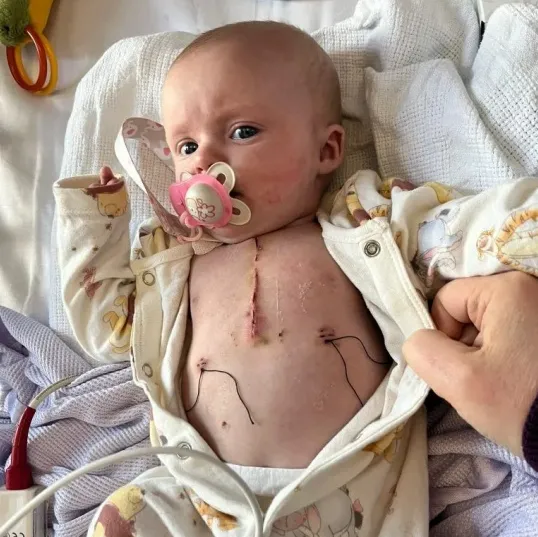
Iris’ breathing became labored, and her color told a story her body could not explain with words.
Doctors acted quickly, assessing her condition and reviewing her earlier diagnosis.
The decision was made—waiting was no longer an option.
At just ten weeks old, Iris was scheduled for open-heart surgery.
The words felt unreal.
She was still so small, still learning how to exist in the world.
And yet, her heart needed to be repaired to save her life.
Handing Iris over to the surgical team was one of the hardest moments Becky and her partner would ever experience.
Trust was all they had.
They waited through long, silent hours, clinging to each other and to the belief that their daughter was strong enough to survive this.
Every second stretched painfully.
The surgery was life-saving.
Surgeons repaired the defects that had compromised Iris’ heart, restoring proper blood flow and oxygenation.
When the news finally came that the operation had been successful, relief broke through in waves.
But survival was only the first step.
Recovery was difficult.
Iris spent time in intensive care, surrounded by machines, wires, and constant monitoring.
Her tiny body had endured trauma far beyond what any infant should experience.
Progress came slowly, one careful milestone at a time.
Becky and her partner remained by her side, learning once again how to wait.
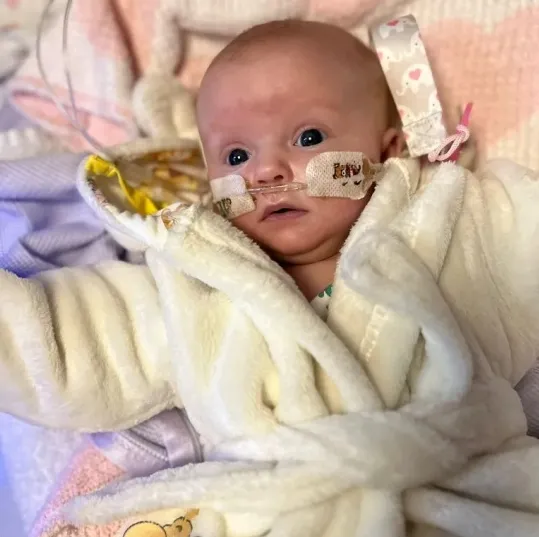
They celebrated the smallest improvements—a stable reading, a peaceful hour, a calm breath.
Fear did not disappear, but it learned to coexist with gratitude.
Each day Iris grew stronger.
As weeks passed, Iris began to show signs of thriving.
Her color improved.
Her energy returned.
The heart that once struggled was now working as it should.
Eventually, Iris went home.
Life outside the hospital felt unfamiliar but deeply precious.
Her parents watched her closely, but also learned to trust her strength.
Slowly, the shadow of fear loosened its grip.
Today, Iris is a happy, energetic toddler.
She runs, laughs, and explores the world with curiosity and confidence.
She meets her developmental milestones and lives without restrictions.
To those who meet her now, it is hard to imagine how fragile her beginnings were.
But Becky never forgets.
She carries Iris’ story with her in every heartbeat, every laugh, every ordinary day that once felt impossible.
And with that memory comes a purpose beyond gratitude.
Advocacy.
Becky speaks openly about the importance of early detection.
She knows that if Iris’ condition had been caught even earlier—through routine pulse oximetry screening—her journey might have been less complicated and less frightening.
Early awareness can change outcomes.
It can save lives.
Pulse oximetry screening is simple, quick, and non-invasive.
Yet in many places, it is not universally implemented.
Becky believes passionately that no family should have to discover a life-threatening heart condition in a moment of crisis.
Knowledge, she knows now, is power.
Iris’ story has become more than a personal journey.
It is a message to parents, healthcare providers, and communities.
Listen closely.
Screen early.
Trust instincts.
For Becky and her partner, Iris represents resilience in its purest form.
She survived uncertainty, surgery, and recovery before she could even speak.
She taught them what strength looks like when wrapped in a tiny body.
And she continues to teach them the value of every ordinary moment.
Iris’ life is a testament to modern medicine, early awareness, and unwavering parental love.
It is proof that a frightening diagnosis does not have to define a future.
And it is a reminder that behind every scan, every statistic, is a child who deserves a chance to live fully.
Her journey began with a blue line on a screen.
But it continues today in laughter, movement, and joy.
Iris is not defined by tetralogy of Fallot.
She is defined by resilience, love, and a heart that refuses to be anything less than strong.