“Mommy, I’m tired. I want to sleep.” When those words come from a four-year-old child, they should be ordinary. For us, they are terrifying. Every time Filipek says them after the slightest effort, we hear what he cannot yet fully understand — his heart is struggling again. His breathing becomes raspy, his body weakens, and the fear we live with every day tightens its grip.
Our son’s heart is in danger once more.
Filipek was born on August 14, 2019. At first, everything seemed normal. We believed we had welcomed a healthy baby boy into the world, and we were preparing to take him home when, on the third day of his life, a doctor heard a heart murmur. We were reassured that it might not be serious, that murmurs often disappear on their own. We clung to that hope, but it shattered quickly.
On the fifth day of his life, Filipek was rushed to the hospital in Prokocim. There, doctors confirmed a devastating diagnosis: a severe congenital heart defect — critical aortic stenosis with coarctation. His heart was dangerously narrowed, and without immediate intervention, he would not survive. On the sixth day of his life, our newborn son was placed on an operating table for life-saving surgery.
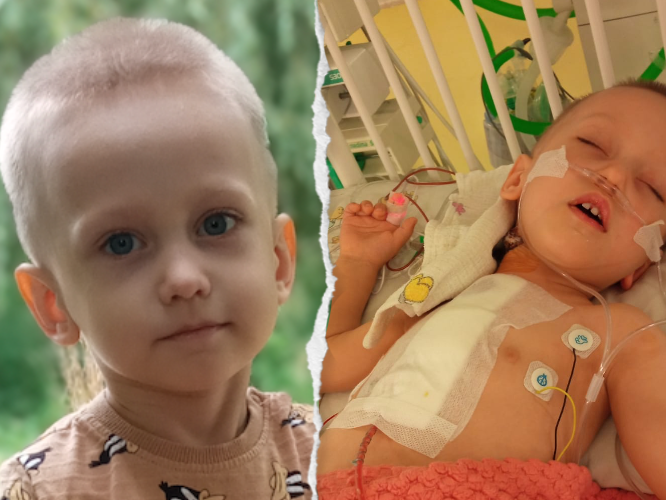
One day he was in our arms. The next, he was fighting for his life in intensive care. Instead of holding him close, we watched through glass walls, praying that machines and medicine would keep our baby alive. After nearly a month in the hospital, we were finally allowed to bring him home. We told ourselves the worst was behind us and tried to begin our life as parents.
But our happiness did not last.
Just four months later, a follow-up echocardiogram revealed that the narrowing in Filipek’s heart had returned. He was immediately referred for cardiac catheterization to widen the affected area, and a stent was placed in his aorta. We hoped this would finally stabilize his condition. Instead, new problems emerged. Doctors discovered a growth at the outlet of his left ventricle, causing further narrowing and forcing his heart to work dangerously hard.
There was a chance the stricture might not progress, that we could avoid or at least delay another surgery. That hope, too, was short-lived. Filipek’s condition worsened, and he was scheduled for yet another open-heart operation. We asked ourselves if this would finally be the end of his suffering. It wasn’t.
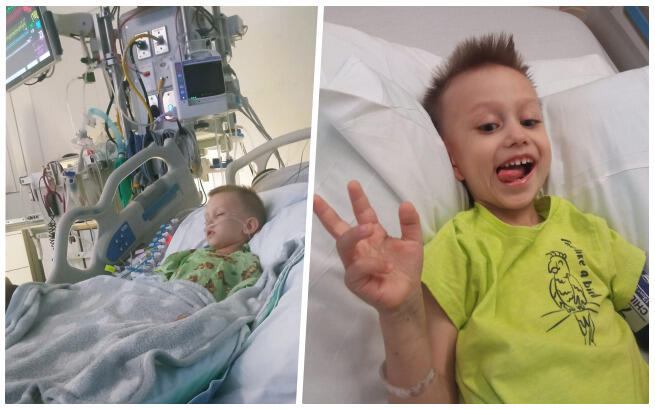
Today, Filipek is four years old, and we have already feared losing him four times as he disappeared behind the doors of the operating room. Each time, surgeons removed the growth. Each time, it returned. Even the doctors are shocked by how aggressive and fast his defect progresses. Every heart surgery carries enormous risk, and our son has faced that risk almost every year of his life.
His most recent surgery was in November 2022. Just one month later, doctors discovered that the narrowing was already returning. The cardiac gradient that qualifies a child for surgery is around 75. Filipek’s has already reached 66 and continues to rise. We live in constant suspense, never knowing when the next operation will become unavoidable.
Beyond the surgeries, Filipek’s childhood is slipping away. He cannot run or lift even a small bucket of sand at the playground. Simple exertion could cause him to faint. He becomes tired quickly, and his breathing grows heavy. He does not attend preschool because even a minor infection could pose a deadly risk to his heart. While other children play freely, our son must constantly be protected.

We have reached a point where local options are no longer enough. As parents, we are grasping for a final hope. We have begun seeking treatment abroad, and one place has given us a real chance —
Boston Children’s Hospital. Doctors there believe they may be able to perform a surgery that could stop this cycle of repeated operations and give Filipek a future without constant fear.
This is more than another surgery. It is a chance for our son to live without pain, without limits, and without the shadow of death hanging over his childhood. We want Filipek to run, to play, to grow up without exhaustion and fear. We want him to sleep because he is tired from joy, not because his heart can no longer keep up.
We are fighting for our child with everything we have. But we cannot do it alone. Filipek’s heart is still beating, and with your help, we hope it will continue to beat strong for many years to come.
